

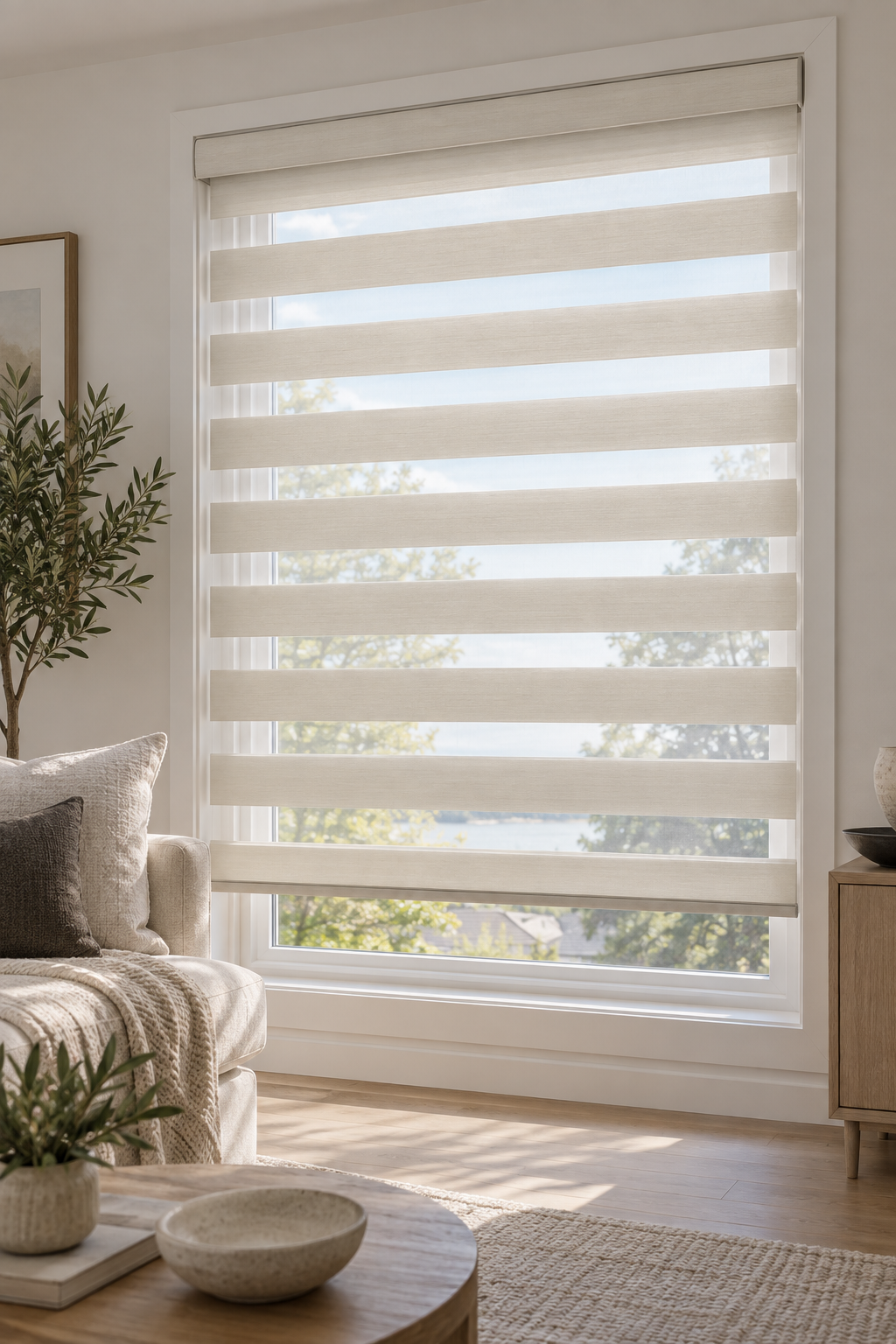
Choosing an automated blinds control system starts with a practical question: do you need straightforward remote operation, or would broader automation make daily life easier? A remote-controlled blind may be enough for one accessible window. App, voice, scheduled, sensor-based, or whole-home control can be more useful when you have several coverings, hard-to-reach windows, or established smart-home routines.
The control method is only one part of the decision. The exact blind, motor, power source, controller, mounting arrangement, and window must work together. Lavish Blinds offers made-to-measure blinds, shades, and shutters, including remote-controlled and automated solutions, with professional measurement and installation.
Quick summary

- Choose a remote when you mainly want direct, simple adjustment.
- Consider app, voice, scheduled, or grouped control when you manage several blinds or want repeatable routines.
- Confirm compatibility for the exact blind, motor, controller, hub, and smart-home platform before ordering.
- Motorization improves access and convenience, but it does not automatically provide blackout, privacy, insulation, or glare reduction.
- Ask about power, charging or replacement access, manual operation, servicing, and installation during a professional measurement and quote.
What an automated blinds control system includes
An automated window blind system usually combines a window covering with a motor, power arrangement, and control method. Depending on the product, operation may involve a handheld remote, an app, voice commands, schedules, sensors, grouped control, or a connection to another smart-home system.
These parts should be assessed as one system rather than selected independently. The correct motor, tube, power source, controls, and mounting arrangement depend on the specific blind and window. Before ordering, confirm product requirements, power or charging arrangements, manual operation, grouping, automation, and compatibility.
It is also important to separate automation from physical performance. A motor controls movement. The fabric, slats, material, opacity, fit, and mounting position determine how the covering handles light, privacy, glare, and room darkening.
Remote, app, voice, and scheduled control compared

| Control method | May suit | Confirm before ordering | Main tradeoff |
|---|---|---|---|
| Remote-controlled | One or several blinds needing convenient direct adjustment | Remote type, pairing, range, and individual or grouped operation | Simple to use, but routines may be limited |
| App-controlled | People wanting phone operation or broader control options | App requirements, account setup, connectivity, and supported products | More features can mean more setup and maintenance |
| Voice-controlled | Hands-free operation or users already using voice assistants | Exact platform compatibility, required accessories, and privacy preferences | Convenient when configured correctly, but compatibility cannot be assumed |
| Scheduled | Repeatable opening and closing routines | Whether schedules require an app, hub, network, or controller | Useful for consistency, but routines need occasional review |
| Sensor-based | People seeking responses to changing light or other conditions | Supported sensors and how automation is configured | More automated behaviour requires careful setup and testing |
| Whole-home or grouped | Several rooms, large windows, or coordinated operation | Grouping limits, room assignments, control hierarchy, and manual override | Efficient for larger installations, but more components must remain compatible |
Local buyers may use terms such as motorized blinds, smart blinds, automated window blinds, app control, voice control, and whole-home control interchangeably. The useful distinction is what the system actually does, which components it requires, and how comfortable you are with setup and ongoing access.
Remote-controlled or smart blinds: which suits your routine?
A remote is often sensible when you want direct operation without introducing a wider control system. It may suit an accessible living-room window, a bedroom adjusted occasionally, or a small installation where each blind can be operated independently.
Broader smart control becomes more valuable when the same action must be repeated across several windows. Grouping may help in an open-plan room, while schedules may suit a consistent morning or evening routine. Voice or app control may also help when windows are high, behind furniture, or otherwise difficult to reach.
- One or two accessible windows: start by comparing manual and remote-controlled operation.
- Several windows in one room: ask whether the products can be grouped and operated together.
- High, large, or difficult-to-reach windows: prioritise access, control location, and manual operation during an interruption.
- Established smart-home routines: verify exact compatibility rather than assuming a familiar platform will work.
- Multiple household or workplace users: clarify who can operate the blinds and how control is shared.
Smart blind automation is separate from building entry or security management. If you are comparing connected-property terminology, access control system types covers that different category.
Power, manual override, and servicing questions
Power planning affects convenience after installation. Depending on the product, a system may use batteries, rechargeable power, or a wired arrangement. The important question is whether the chosen arrangement is practical for the window and accessible for future attention.
Ask where a battery or charging connection is located, how it is accessed, and what happens when power is interrupted. Confirm whether the blind can be operated manually, whether a remote is available as a backup, and how several coverings behave if one component is unavailable.
Also consider servicing. A skylight, tall window, or covering behind fixed furniture may be easy to automate but difficult to reach later. Discuss charging, replacement, control access, and maintenance before ordering.
Compatibility checks before ordering
Compatibility is product-specific. A motor must suit the blind’s construction, size, weight, tube or operating mechanism, and available mounting space. The controller, app, hub, voice assistant, sensor, and smart-home platform must then support that exact motor and configuration.
Do not assume that a familiar voice assistant, app, or platform will work simply because another smart device in the home uses it. Confirm the exact model, any required bridge or hub, network requirements, grouping options, schedules, sensor support, and what happens if the internet or local connection is unavailable.
Existing blinds should also be assessed before considering a motor retrofit. The blind’s tube, brackets, fabric weight, mechanism, age, and available space may not suit a particular motor. A conversion may also fail to deliver the desired appearance or control features.
- Is this motor designed for this exact blind or shade?
- Does the system require a hub, bridge, app, or network connection?
- Can the blinds be operated individually and as a group?
- Are schedules, voice commands, or sensors supported by this configuration?
- What manual or backup operation is available?
- Can the control or power components be reached for servicing?
What motorization does not solve
Motorization addresses operation and access. It does not automatically make a covering blackout, improve insulation, remove glare, or guarantee privacy at every time of day. Those results depend on the selected material, opacity, fit, mounting position, window frame, surrounding trim, and gaps around the covering.
A motorized light-filtering roller blind remains light filtering. If darkness is the priority in a bedroom, compare blackout fabrics or shades and discuss side, top, and bottom gaps. A motor can make a blackout covering easier to operate, but it does not create blackout performance by itself.
Similarly, a motorized blind may reduce the need to reach a window, but it does not resolve poor sizing or an unsuitable mounting position. Choose the covering around the room’s functional requirement first, then choose the operating method.
Window, mounting, and installation planning
Made-to-measure assessment matters because motorized coverings need sufficient space for the product, motor, brackets, and control components. Before the consultation, note approximate dimensions, recess depth, trim, handles, nearby furniture, door movement, and whether the window is unusually large, high, shallow, or angled.
Inside mounting may create a clean appearance when the recess allows it. Outside mounting may be more practical when trim, limited depth, handles, or light gaps affect the result. The correct choice depends on the window and covering, so it should be confirmed during measurement rather than assumed from a photograph.
Installation should include checks for alignment, clearance, movement, control response, grouping, and access to power or operating components. In condos and offices, confirm any building, access, scheduling, or mounting requirements before installation.
Which setup fits these common situations?
Tall window
Convenient operation is likely the main reason to consider motorization. Compare remote and smart control based on whether the window is adjusted occasionally or as part of a wider routine. Confirm how the system will be reached if the remote, battery, or control connection needs attention.
Skylight
A skylight can benefit from motorized operation because manual access may be awkward. The main tradeoff is service access. Discuss mounting, power, control location, and manual operation before choosing the covering.
Bedroom
Start with the required level of darkness and privacy, then choose the operating method. Motorized blackout shades may be convenient, but fabric, fit, mounting, and edge coverage still determine room-darkening performance.
Condo
Consider recess depth, trim, handles, limited mounting space, and building requirements. A remote may be sufficient for one room, while grouped or scheduled operation may help when several windows need the same routine.
Open-plan room
Grouping can reduce repetitive adjustment across several coverings. Confirm whether each blind can also be operated separately, since windows in one room may have different sunlight, privacy, or glare requirements.
Office
Prioritise simple control, glare management, user access, and reliable operation. Smart features may be practical when several windows need coordination, but a straightforward remote system may be easier when there are few coverings or changing users.
Pre-order checklist for an automated blinds quote
- Room goal: Is the priority access, privacy, glare reduction, daylight adjustment, room darkening, appearance, or convenience?
- Window details: What are the approximate dimensions, recess depth, trim, handles, obstructions, and access limitations?
- Covering: Which blind, shade, or shutter provides the required opacity, material, and style?
- Control: Do you need manual, remote, app, voice, scheduled, sensor-based, or grouped operation?
- Compatibility: Does the exact motor work with the desired controller, app, hub, platform, or sensor?
- Power: How is the system powered, charged, replaced, or serviced?
- Backup operation: What happens during an interruption or if the primary control is unavailable?
- Installation: Will mounting, clearance, alignment, movement, grouping, and control response be tested?
- Quote: Does it identify the product, measurements, material, motor, controls, power arrangement, installation, and aftercare?
What to expect from a professional measurement and quote
A useful consultation should connect the room’s needs to the window’s physical conditions. Prepare to explain when the covering is used, who operates it, whether several windows need coordination, and what you expect from privacy, light control, or room darkening.
Lavish Blinds provides made-to-measure blinds, shades, and shutters for homes, condos, offices, and commercial spaces in Oakville and the Greater Toronto Area. Its process includes personalized design guidance, free on-site measurement and quotes, and professional installation.
Before approving the order, ask the installer to confirm the product, mounting position, operating method, power arrangement, compatibility, manual override, and post-installation guidance. This is the point to resolve uncertainties, not after the coverings have been fabricated.
Frequently asked questions
Do automated blinds need Wi-Fi to work?
Not necessarily. A remote-controlled system may operate directly without the same network features as an app-based or smart-home system. Ask whether the exact product requires Wi-Fi, a local connection, a hub, or an app, and what remains available if the network is interrupted.
Can existing blinds be fitted with a motor?
Sometimes, but it cannot be assumed. The blind’s construction, tube, brackets, mechanism, weight, age, and available space must be assessed against the motor. A professional should confirm whether a retrofit is compatible and whether it will provide the desired appearance and control.
Are smart blinds practical for a small office?
They can be, especially when several windows need coordinated operation or access is inconvenient. However, a remote may be more practical for a small number of accessible coverings. Compare setup complexity, user access, power, manual operation, and maintenance before choosing.
Do motorized blinds automatically provide blackout?
No. Motorization controls movement, while blackout performance depends on material, opacity, fit, mounting position, window construction, and gaps around the covering. Specify the desired light-control result separately from the motor and control method.
Conclusion: choose the control level that fits the window and routine
The best automated blinds control system is the one that solves a real access or operating problem without adding unnecessary complexity. Start with the room, window, users, and desired light or privacy performance. Then compare a remote, app, voice, scheduled, sensor-based, or grouped setup.
Before ordering, verify the exact blind, motor, controller, power arrangement, compatibility, mounting, manual operation, and installation checks. Motorization can make a well-specified covering easier to use, but it cannot compensate for unsuitable opacity, poor fit, or an impractical installation plan.
To discuss your window requirements, control preferences, and power needs through a free on-site measurement and quote, contact Lavish Blinds.