

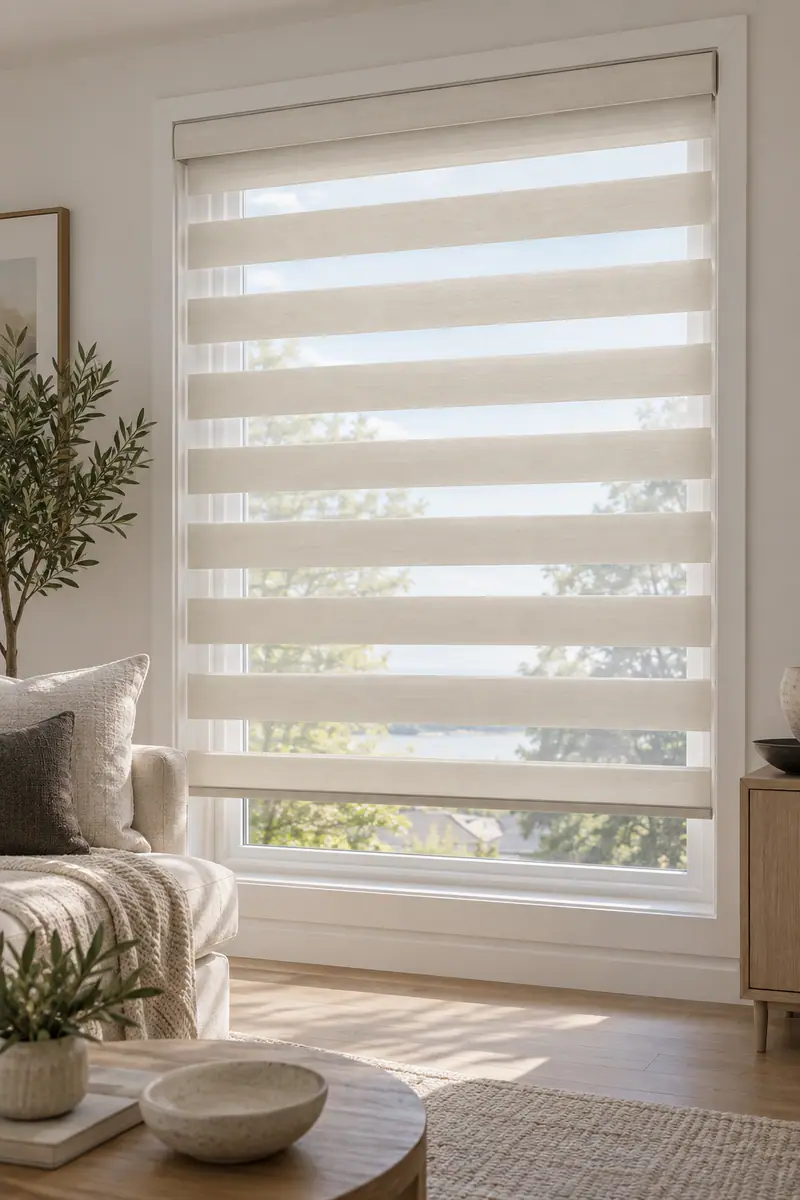
Yes, blinds can be fitted to French doors, but the best option depends on the glass-panel width, handle position, frame depth, door swing, and how often the doors are used. Roller blinds are often a streamlined starting point for individual panels, while faux-wood or Venetian blinds, shades, shutters, and curtains may suit different privacy, style, clearance, or room-darkening priorities.
French doors need a door-specific covering plan because their glass is close to moving hardware. A suitable treatment must provide the coverage you want without catching on handles, restricting the door swing, colliding with the opposite panel, or becoming awkward to adjust every time you pass through. Related reading: 7677 ove decors canberra 48 in frameless soft close sliding shower door black.
Which coverings work best for French doors?

There is no single best covering for every French door. The right choice depends on whether you are covering each narrow glass panel separately or treating a wider opening as one composition, along with your priorities for privacy, daylight, glare, darkness, appearance, and access.
| Covering | Often suits | Advantages | Points to check |
|---|---|---|---|
| Roller blinds | Individual glass panels and streamlined interiors | A single fabric panel gives a clean profile and can be selected around privacy and light-control needs. | Tube, fabric, mounting position, handle projection, bottom clearance, and how the blind moves with the door. |
| Faux-wood or Venetian blinds | Rooms where adjustable slats and a structured appearance matter | Slats allow you to change the balance between privacy and daylight while adding a defined finish. | Slat depth, product weight, handle clearance, door movement, and material care. |
| Vertical blinds | Wider connected openings or several panes treated together | The vanes can cover a broad opening and stack to one side when the space allows it. | Stack direction, traffic path, handle clearance, furniture, and whether the opening behaves more like a patio door. |
| Roman, cellular, or other shades | Softness, comfort, texture, or stronger room-darkening priorities | Shades offer a range of visual finishes and operating approaches that can be coordinated with the room. | Raised stack height, fabric depth, edge gaps, door clearance, and the way the shade operates near the handle. |
| Shutters | A permanent, architectural look | Panels and louvres can create a substantial built-in appearance with adjustable privacy and daylight. | Panel swing, frame depth, handle access, door clearance, and the space required when panels open. |
| Curtains | Full-width softness or a treatment held away from the doors | A curtain can cover the whole opening and stack clear of the glass when the wall has enough room. | Stack space, nearby furniture, access to the doors, and whether the fabric will be moved frequently. |
Roller blinds for a clean individual-panel treatment
Roller blinds use a single fabric panel that rolls around a tube when raised. They can be a practical starting point when each French-door leaf has its own glass panel and you want a simple appearance with independent operation.
Fabric, opacity, mounting position, and clearance all affect how a roller blind performs at a door. The discussion of custom roller blinds is useful when comparing fabric, light control, operating style, and accurate measurement around handles and frequently used openings.
Faux-wood or Venetian blinds for adjustable privacy
If you prefer a structured, wood-inspired look, faux-wood blinds can offer adjustable privacy and daylight control while you assess how the slats will operate around the French-door handles. Their suitability depends on the material, finish, mounting method, fit, and operating style.
Slats need enough clearance to tilt and raise without striking a handle or nearby trim. A heavier blind may also feel inconvenient on a door that is opened repeatedly, so panel size and frequency of use belong in the decision. Compare the practical considerations for faux-wood blinds before choosing this direction.
Vertical blinds for wider connected openings
Vertical blinds are more naturally suited to broad openings than to two narrow, independently moving French-door leaves. They may make sense when the doors form part of a wider glazed opening and there is room for the vanes to stack without obstructing the traffic path.
Check which way the vanes would stack, whether that side is clear, and whether the handle or door swing would interfere with the track or vanes. For a frequently used opening, a simpler individual-panel treatment may be easier to live with.
Shades, shutters, and curtains for different design priorities
Roman, cellular, and blackout shades can be considered when the room needs a softer finish, a particular fabric treatment, or stronger control of incoming light. A shade does not automatically provide complete darkness. Fabric, mounting position, fit, and edge gaps determine the result.
Shutters can provide a more architectural appearance, but their panels and frames need room to move. Curtains can be preferable when you want a soft full-width treatment that remains clear of the doors while open, provided there is enough wall space for the fabric to stack.
Choose by the door, room, and daily routine
The best way to cover French doors is to match the treatment to the door’s movement and the room’s routine. Start by asking whether the doors open inward or outward, whether one leaf is used more often, whether each glass panel is narrow, and whether the covering will be adjusted once a day or every time someone passes through.
If the doors open inward
Allow for the treatment’s projection inside the room, along with handles, furniture, radiators, and the path of the moving leaf. A covering that looks suitable when the door is closed may become inconvenient if it strikes a chair or must be raised each time the door opens.
If the doors open outward
The interior treatment still needs to clear handles, hinges, and the frame, but the exterior swing may affect whether curtains, furniture, or outdoor elements restrict access. Identify the active leaf and direction of movement before deciding where a blind or curtain should stack.
If one door leaf is used more often
Independent coverings can allow the frequently used leaf to be adjusted without moving the treatment on the less-used panel. Matching fabrics or finishes across both leaves preserves a coordinated look while allowing each side to function around its own hardware.
Living room or family room
Prioritize the balance between privacy, daylight, glare, and appearance. If the doors face a bright garden or street, adjustable slats or a light-filtering shade may be useful. For television viewing, consider how fabric opacity, mounting, and side gaps affect glare.
Bedroom
Room darkening and privacy usually matter more than a fully open view. Compare blackout roller blinds, blackout shades, cellular options, or curtains, but assess likely light gaps around the frame. Motorized operation may be worth discussing if the doors are tall, difficult to reach, or adjusted at bedtime and in the morning.
Home office
Consider screen glare, video-call backgrounds, privacy, and whether the door is used during working hours. A streamlined roller blind or shade can keep the area visually calm, while adjustable slats can redirect daylight without fully closing the covering.
Office or exterior-facing doorway
Traffic, privacy, and frequent adjustment become more significant in a workplace. Note desks, shelving, reception furniture, and the direction of movement. The priorities used for commercial window shades can help you assess glare, privacy, operation, maintenance, and installation around a busy opening.
Handle clearance and mounting: the details that prevent fit problems

Choosing the right blinds for your windows starts with the opening, not a standard size. A measured assessment should record the frame, recess depth, handle projection, hinge locations, door swing, nearby obstructions, glass-panel alignment, and space available above and beside the doors.
Inside mount versus outside mount
An inside mount places the treatment within the recess or frame area. It can give a neat finish, but the available depth must accommodate the headrail, roller tube, brackets, or shade stack without colliding with the handle or reducing door clearance.
An outside mount places the treatment on the wall or surface around the opening. It can provide more coverage when the recess is shallow, but the installer must assess trim, wall space, handle reach, hinge clearance, and the treatment’s projection into the room.
Check every moving and projecting part
- Measure the handle projection from the door face, not only the glass width.
- Record hinge positions and check whether the treatment can move past them.
- Identify which leaf opens first and which leaf is used most often.
- Check the bottom of the treatment against flooring, a threshold, furniture, or a radiator.
- Decide where a roller blind, curtain, vertical blind, or shutter would stack when open.
- Check whether paired panels need separate operation to preserve access.
- Compare the appearance with both doors closed and with one leaf open.
A hypothetical living-room example
Imagine a living room with inward-opening French doors, one frequently used handle, a sofa close to one side, and strong afternoon glare. A sensible assessment would record handle and sofa clearance, then compare independently operated roller blinds with slatted blinds or curtains that can stack away from the active leaf.
If privacy is needed during the day but the view is valuable, adjustable slats or light-filtering fabric may be considered. If evening darkness matters more, discuss a room-darkening option and the remaining gaps around the frame. This is a planning example, not a Lavish Blinds project or a guarantee.
Choose manual, cordless, or motorized operation
The material and operating method are separate decisions. Manual operation may suit a reachable door adjusted occasionally, while cordless, inaccessible-cord, remote-controlled, or motorized options can be considered when the covering is within easy reach of children or pets, difficult to access, or used frequently.
Health Canada states that Canadian regulations for corded window coverings came into force in 2021 and that coverings without long accessible cords are the safest choice. The requirements apply to consumer corded window coverings sold in Canada, including products installed in residences or other buildings when they may reasonably be obtained by consumers for non-commercial use. Health Canada’s window-covering safety guidance provides the consumer explanation. The Corded Window Coverings Regulations overview provides the regulatory context.
For a French door, ask how the chosen control will sit in relation to the handle and traffic path. Motorized or smart operation may be worth discussing for tall doors, paired panels, awkward access, or frequent adjustment. Confirm the specific control, power, compatibility, and manual-use arrangements for the proposed covering.
A practical French-door measurement and installation checklist
Prepare the following information before requesting a measured quote. It keeps the conversation focused on how the doors actually work instead of treating them like ordinary windows.
- Photograph the full opening. Include the frame, handles, hinges, floor or threshold, nearby furniture, and the wall above and beside the doors.
- Identify the configuration. Note whether the doors are paired, which leaf opens first, whether one leaf is inactive, and whether they open inward or outward.
- Record obstructions. List handles, locks, trim, radiators, shelving, furniture, curtains, and anything affecting mounting or movement.
- Describe priorities. State whether you need privacy, daylight, glare reduction, room darkening, softness, or a consistent look with nearby windows.
- Describe the routine. Explain how often the doors are opened and how often you expect to adjust the covering.
- Discuss mounting. Compare inside and outside mounting, recess depth, bracket projection, bottom clearance, and stack position.
- Plan paired-panel operation. Decide whether each panel needs independent operation or whether a shared treatment suits the opening.
- Confirm controls and safety. Discuss manual, cordless, inaccessible-cord, remote-controlled, or motorized operation for the specific product.
- Test the finished installation. Open and close each door, operate each covering, check handles and hinges, and confirm that it stacks or raises as planned.
An on-site assessment is especially useful when French doors have narrow panels, limited recess depth, unusual trim, or a busy access path. It allows the proposed covering and installation details to be considered alongside the way the doors operate.
When curtains or shutters make more sense than blinds
Curtains can be better than blinds when you want full-width softness, broad coverage, or a treatment held away from the doors. They work best when the wall provides enough room for the fabric to stack and the curtain will not interfere with handles, furniture, or frequent traffic.
Shutters may suit you when a permanent architectural finish and adjustable louvres matter more than a minimal profile. Their panels require room to swing, so frame depth, handle position, door movement, and access must be assessed first. The room-specific approach used when comparing shutters for different window conditions applies here too: material and appearance matter, but fit and daily use decide whether the treatment is practical.
French-door blinds: questions to ask before ordering
Can you put blinds on French doors?
Yes, blinds can be installed on French doors when the product, mounting position, and operating method are planned around the glass panels and door hardware. The assessment should cover handles, hinges, frame depth, door swing, bottom clearance, and whether each leaf needs independent operation.
What type of blinds are best for French doors?
Roller blinds are often a practical starting point for individual panels, while faux-wood or Venetian blinds suit adjustable slats, vertical blinds suit wider connected openings, and shades or shutters suit different room-darkening, softness, or architectural priorities. The best choice meets the room’s light and privacy needs without obstructing movement.
Are curtains better than blinds for French doors?
Curtains are often preferable when you want a soft full-width treatment that stacks away from the doors, while blinds are often easier to coordinate with individual glass panels and independent access. The better option depends on wall space, traffic, handle clearance, and how often the doors are opened.
How do you keep French-door blinds from hitting the handles?
Measure the handle projection, select a suitable mounting position, check the product’s depth, and allow enough clearance for the blind to raise, tilt, roll, or stack. A professional on-site measurement can assess the handle, frame, hinges, and door movement together.
Are cordless or motorized blinds safer for French doors?
Cordless or inaccessible-cord coverings avoid long accessible cords, and motorized operation can reduce the need to reach across a frequently used or awkward door. Health Canada identifies coverings without long accessible cords as the safest choice, so operation and cord safety should be discussed before selecting the product. Source: Industry guidance related to the Corded Window Coverings Regulations: Scope - Canada.ca.
Should French-door blinds be mounted inside or outside the frame?
Inside mounting can look neat when the recess has enough depth and the hardware clears the handle, while outside mounting can help when the recess is shallow or more coverage is needed. Neither position is universally correct because the frame, trim, handle, hinges, door swing, and selected product all affect the decision.
Plan a measured French-door covering consultation in Oakville
For French doors, a successful choice begins with the way the opening is used, not with a standard blind size. Note the hardware and movement, decide what you need from privacy and light control, then compare the covering categories around the available clearance.
To discuss a measured French-door covering solution in Oakville, explore Lavish Blinds’ custom window-covering services.