

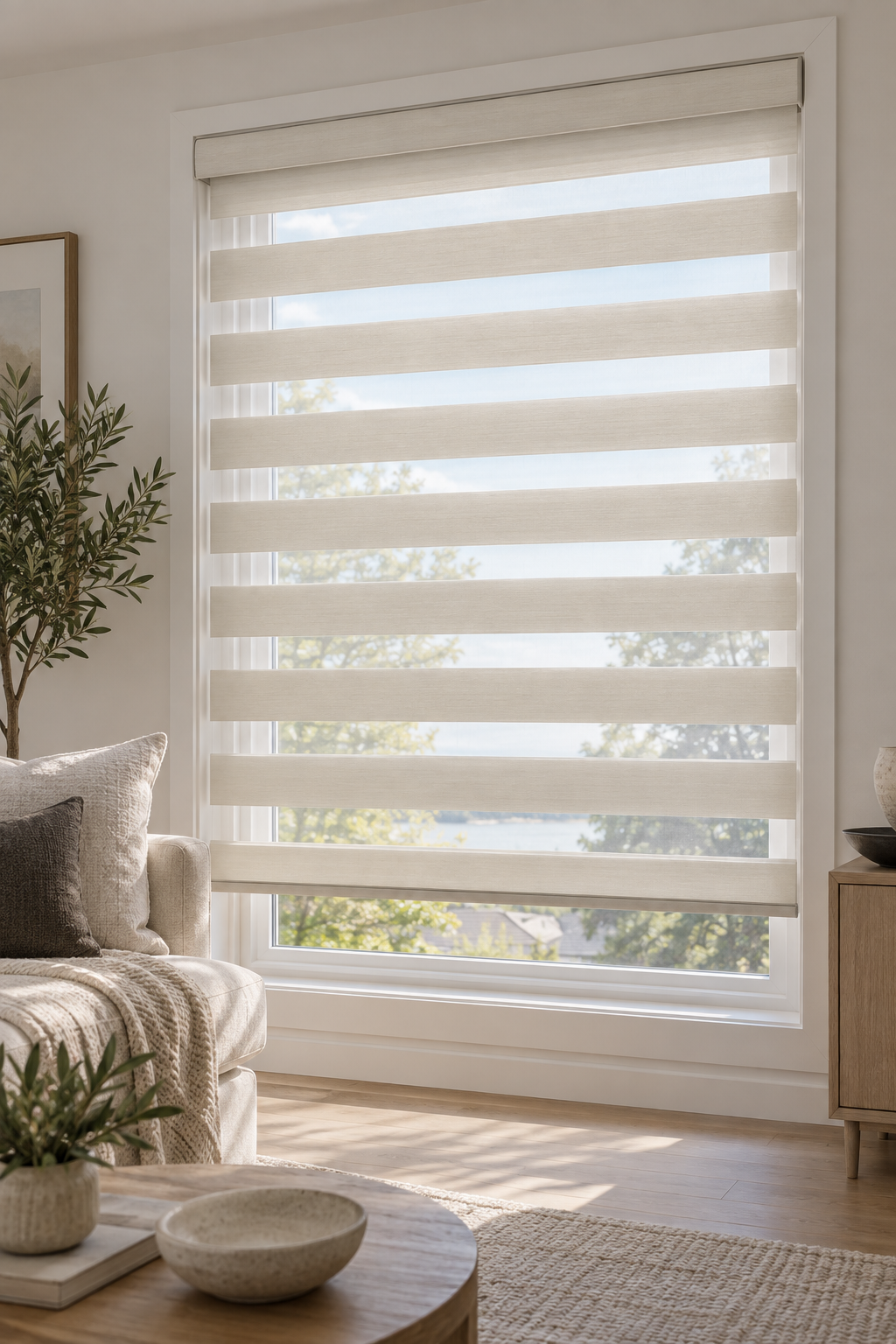
Durable commercial blinds for a Toronto office are not chosen by material name alone. Long-term performance depends on how often the blinds are adjusted, the size and shape of the windows, exposure to glare, privacy requirements, hardware, cleaning access, accurate measurement and installation.
For a multi-window office, the right choice is usually the system that suits the working environment and can be specified consistently across the space. A product that looks appropriate in a sample may be less suitable if it is difficult to operate, clean or repair once installed.
Quick summary

- Match the blind category to operating frequency, glazing size, glare and privacy needs.
- Compare material, hardware, controls, cleaning requirements and replacement parts, not just appearance.
- Use precise measurements and coordinated installation to support consistent alignment across multiple windows.
- Ask about product-specific warranty terms, control compatibility and maintenance before ordering.
- Confirm whether Ontario Fire Code or Building Code requirements apply to the selected materials and building use.
What durability means for commercial office blinds
In an office, durability means more than resisting visible wear. It includes dependable operation, stable mounting, consistent appearance across several windows, cleanability and the ability to maintain or replace relevant components. A blind also needs to remain practical when employees adjust it repeatedly or when a facilities team must service it without disrupting work.
Office conditions vary considerably. A private office with occasional adjustments has different demands from a meeting room with strong screen glare, a client-facing studio or a tall glazed wall that is difficult to reach. No single material is universally the most durable for every Toronto workplace.
When comparing commercial window coverings, ask whether the proposed system is suited to the window dimensions, mounting surface and expected pattern of use. The supplier should also explain what is included in the hardware, how the blinds are cleaned and which parts can be replaced if a component is damaged.
Commercial office blinds compared by use and durability factors

The following comparison is a starting point rather than a ranking. Product construction, fabric, hardware and installation details can change the practical result.
| Option | Often considered for | Potential strengths | Questions to verify |
|---|---|---|---|
| Roller blinds | Private offices, meeting rooms and consistent multi-window coverage | Clean visual lines and a compact profile | How will fabric openness, glare control, privacy and cleaning needs be balanced? |
| Venetian blinds | Rooms needing adjustable daylight and privacy | Slatted adjustment allows more control over light direction | Which material and operating hardware suit the cleaning routine and usage level? |
| Vertical blinds | Wide windows and glazed openings | Track-based coverage can suit broad expanses | How will the track, slat movement, opening direction and replacement components be managed? |
| Faux-wood blinds | Offices seeking a structured, wood-look appearance | Made-to-measure coverage with adjustable light and privacy | What are the product's cleaning, weight, hardware and moisture limitations? |
| Cellular shades | Spaces where comfort and filtered light are priorities | Cellular construction adds a layer between the room and glass | What fabric, opacity, operating system and maintenance requirements apply? |
| Motorized blinds | Tall, hard-to-reach or frequently adjusted windows | Convenient operation without reaching individual coverings | Which controls, power arrangement, compatibility, servicing and manual override are included? |
Roller blinds for consistent office coverage
Roller blinds can suit offices that need a visually consistent treatment across several windows. Their suitability depends on the fabric and control system selected. Screen-facing work areas may need glare reduction, while meeting rooms or street-facing offices may place more emphasis on privacy. A room used for presentations may require a different opacity from a reception area.
Before choosing, ask how the fabric will behave in changing daylight, whether the finished coverage is appropriate for the window, and how the tube, brackets and control will be accessed for cleaning or service. Made-to-measure roller blinds can help coordinate proportions across a multi-window installation, but the final specification still needs to reflect each opening.
Venetian and faux-wood blinds for adjustable light control
Venetian blinds are useful when occupants need to adjust the direction and amount of daylight rather than simply raise or lower a covering. Wood, faux wood and aluminium can differ in weight, finish, cleaning requirements and suitability for the surrounding environment, so the decision should be based on the office's operating conditions rather than appearance alone.
Faux-wood blinds may appeal where a structured wood-look finish is desired, but confirm the product's dimensions, hardware requirements and care instructions. For a more detailed material comparison, review the differences between wood, faux wood and aluminium Venetian blinds before requesting a specification.
Vertical blinds for wide windows and glazed openings
Vertical blinds are often considered for broad windows, patio-style doors or other large glazed openings. The track, slat movement and opening direction matter as much as the visible covering. A busy walkway beside the window may require a layout that avoids repeated contact, while a frequently used opening needs an operating arrangement that does not obstruct traffic.
Ask how the system will be supported, where the controls will sit, how the slats can be cleaned and whether individual components can be replaced. Wide or tall glazing should be measured as part of the actual office rather than estimated from nominal window sizes.
Cellular and motorized options for specific office needs
Cellular shades may be considered where a workplace needs filtered light and improved comfort near the glass. They are not automatically the best choice for every office, so confirm the opacity, fabric, operating method and cleaning instructions for the proposed product.
Motorized blinds can be practical for tall windows, hard-to-reach openings or spaces where several coverings need to be adjusted together. The durability question shifts from cords and manual controls to the complete control system: confirm power, charging or battery arrangements, compatibility, manual operation, servicing and responsibility for future maintenance. A control setup should be documented before the order is approved. A guide to choosing an automated blinds control system can help structure that discussion.
Match the window covering to the office environment
Start with the room's operating conditions, not a preferred product label. Consider these common scenarios:
- Screen-heavy work areas: prioritise glare control without creating an unnecessarily dark room.
- Meeting rooms: consider privacy, presentation conditions and whether the blinds will be adjusted frequently.
- Client-facing spaces: coordinate colour, proportions and operating controls across visible windows.
- Tall or wide glazing: verify access, hardware, opening direction and whether motorized operation is appropriate.
- Multi-window offices: specify finishes and controls consistently, while accounting for differences in each opening.
- High-traffic areas: assess whether employees, furniture or doors may contact the blinds or controls.
Lavish Blinds describes its commercial assessment around glare, privacy, opening sizes and operating needs. Its commercial service covers offices, studios, professional practices and client-facing spaces, with measurement and professional installation coordinated as one project. This type of assessment is more useful than choosing from a sample without discussing the actual rooms.
Why measurement and installation affect long-term performance
Even a well-suited blind can perform poorly if it is measured or mounted incorrectly. Inaccurate dimensions may create uneven gaps, misaligned sightlines or unnecessary strain on operating components. In a multi-window office, small inconsistencies can also become visually obvious across a wall of glazing.
Professional commercial blinds installation should account for the opening, mounting surface, hardware clearance, control position and relationship between adjacent windows. Ask who is responsible for confirming site conditions, protecting finished interiors, coordinating access and checking operation after installation.
Made-to-measure blinds and professional fitting do not remove the need for product-specific checks. The quote should still identify the selected material, dimensions, hardware, control method, finish, installation scope and any exclusions.
Commercial blinds procurement checklist
Use this checklist when comparing suppliers or reviewing a quote:
- Use: How often will each blind be adjusted, and who will operate it?
- Window conditions: What are the exact widths, heights, recesses, glazing types and access limitations?
- Light and privacy: What level of glare reduction, privacy or room darkening is needed in each room?
- Material and hardware: Is the selected construction appropriate for the environment, weight and operating pattern?
- Cleaning: Can staff or contractors clean the fabric, slats, tracks and controls without special equipment?
- Replacement parts: Which components can be replaced, and how are repairs or adjustments requested?
- Controls: For motorized blinds, what powers the system, what controls it and what compatibility limits apply?
- Warranty: What exactly is covered, for how long, and are labour, controls and installation treated separately?
- Installation: Who measures, supplies hardware, installs, tests operation and removes packaging?
- Project coordination: How will delivery, access, noise, dust and work hours be managed around office operations?
- Documentation: Will the final specification include product details, care instructions, control information and warranty terms?
It is worth using the same disciplined questions for any contractor appointment, especially where access, scheduling and responsibilities affect the result. A general installation planning checklist can provide a useful prompt for documenting those practical details, even though the product requirements will differ.
Toronto and Ontario compliance checkpoint
Office blinds can form part of an interior finish or decorative installation, so project-specific requirements should be confirmed before materials are ordered. Ontario requirements may apply to interior finish materials, furnishings and decorative materials, including specified textile and film applications under the Fire Code: Ontario Fire Code requirements.
The 2024 Ontario Building Code Compendium also states that interior finishes, furnishings and decorative materials must conform to applicable Fire Code or National Fire Code provisions, subject to stated exceptions. Review the Ontario Building Code fire protection provisions with the responsible building professional, property manager or authority having jurisdiction. Do not assume that a product is compliant without documentation for the specific material, occupancy and installation.
How a commercial blinds assessment can support the decision
A practical assessment should connect the office's use to the proposed window-covering system. For Toronto projects, Lavish Blinds identifies consultation, measurement and installation as services to be confirmed by address, while its commercial offering is described for Oakville and nearby Greater Toronto Area service areas.
When requesting an assessment, provide window counts, approximate dimensions, room uses, glare concerns, privacy requirements, access restrictions and any building or property-management rules. Ask for alternatives where more than one category could suit the space, along with the maintenance, control and warranty implications of each.
Frequently asked questions
How long should commercial office blinds last in Toronto?
There is no single standard lifespan for all commercial office blinds. Service life depends on construction, operating frequency, installation, cleaning, exposure and maintenance. Ask for product-specific warranty terms and care instructions instead of relying on a general number.
Which blinds are practical for an office with many windows?
Roller blinds, Venetian blinds, vertical blinds and other made-to-measure options may be practical, depending on the window sizes, glare, privacy and operating pattern. The important comparison is whether the system can be specified consistently while still fitting each opening correctly.
Should commercial office blinds be professionally measured and installed?
Professional measurement and installation are advisable when an office has multiple windows, tall glazing, unusual openings or strict alignment requirements. The installer should confirm dimensions, mounting conditions, hardware clearance and operation rather than relying only on standard sizes.
Are motorized blinds suitable for a Toronto office?
They may be suitable for tall, hard-to-reach or frequently adjusted windows. Confirm the power arrangement, controls, compatibility, manual override, servicing process and future maintenance before selecting a motorized system.
Do Ontario building or fire requirements affect office blinds?
They may, depending on the material, installation, occupancy and building circumstances. Confirm applicable requirements with the responsible building professional or authority and request documentation for the selected product instead of assuming that every blind has the same classification.
Choose the system, not just the blind
The most durable commercial office blinds are the ones that match the actual working environment. Begin with operating frequency, glare, privacy, window dimensions, traffic and cleaning access, then compare suitable categories by material, hardware, controls and maintenance.
For a Toronto office, the procurement decision should also include precise measurement, coordinated installation, documented warranty terms and a project-specific Ontario compliance review. A supplier that assesses the space before recommending products can help reduce avoidable fit and operating problems.
Lavish Blinds provides made-to-measure window coverings, free on-site measurement and quotes, and professional installation. To discuss commercial blinds for a Toronto-area office, contact Lavish Blinds and confirm project suitability by address.