

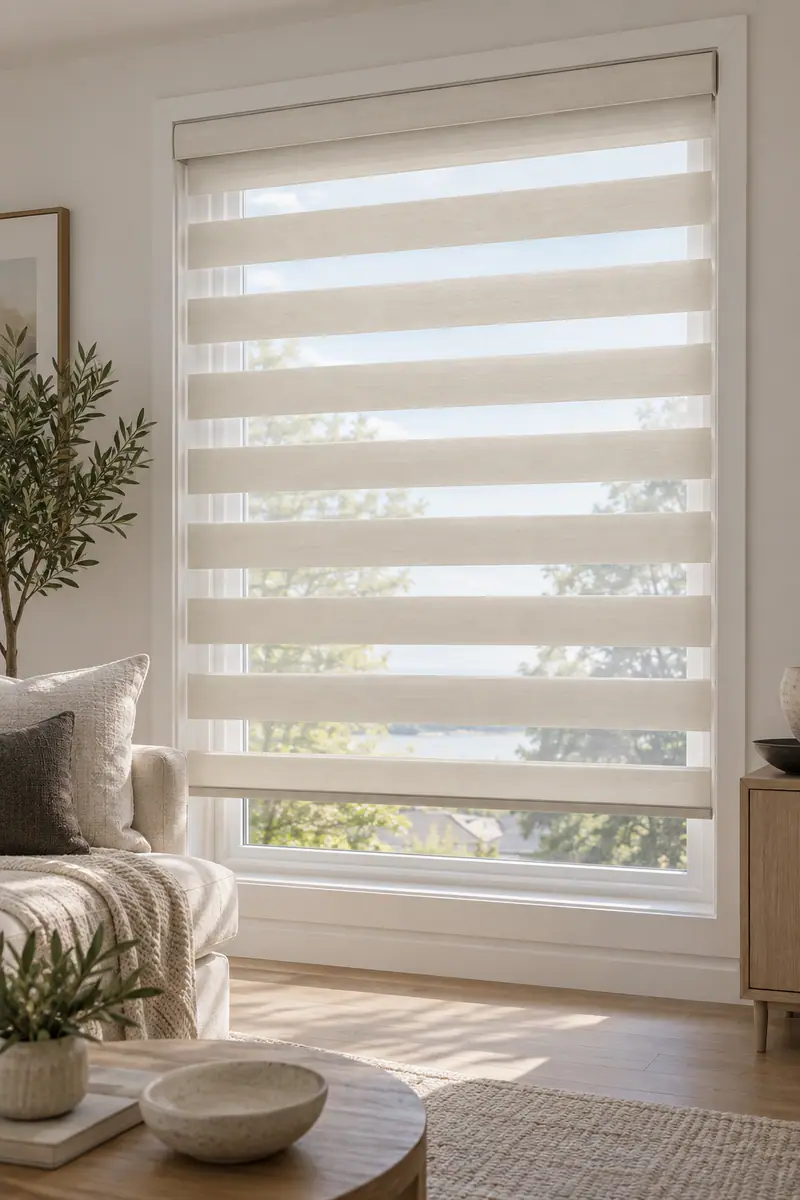
The best commercial window shades in Oakville depend on what each space must control. Solar or screen-style shades suit glare and screen visibility, roller shades offer a clean general-purpose solution, blackout shades suit presentation or controlled-darkness spaces, and cellular shades are worth considering where window comfort matters. Lavish Blinds provides made-to-measure commercial window treatments with coordinated measurement and professional installation for offices, studios and client-facing spaces. Related reading: Door and Window Deterioration Signs for GTA Homeowners.
Commercial shade types compared by performance and setting

No single shade works equally well in a boardroom, street-facing clinic and open office. Start by separating the job into glare, privacy, daylight, room darkening, appearance, maintenance and operation.
| Shade direction | Useful strengths | Trade-offs to consider | Commercial settings to assess |
|---|---|---|---|
| Roller shades | Clean profile, straightforward light control and a consistent appearance across multiple windows | The fabric choice determines how much daylight, privacy and darkness you receive | Private offices, reception areas, general workspaces and client-facing rooms |
| Solar or screen-style shades | Useful for reducing visual glare while retaining some daylight and an outward view, depending on the selected fabric | Privacy and darkness vary with the fabric, lighting conditions and viewing direction | Computer workstations, street-facing offices, reception desks and storefronts |
| Blackout shades | Strong control of incoming light and views through the shade surface | Edge gaps, mounting position and side-light expectations still affect the room result | Boardrooms, presentation rooms, training rooms and hospitality spaces |
| Cellular shades | Honeycomb construction adds a pocketed layer at the window, with opacity options from softly filtering to room darkening | They need careful sizing and may not be the first choice when a formal or architectural look leads | Offices affected by seasonal window discomfort, quiet rooms and private work areas |
| Woven shades | Natural texture and visual warmth for spaces where the window treatment contributes strongly to the design | Light filtering, privacy and cleanability depend on the material and lining selected | Hospitality interiors, studios, lounges and design-led reception areas |
| Sheer shades | Soft daylight and a lighter decorative appearance | They are not automatically a privacy or presentation-darkening solution | Client-facing areas, lounges and spaces where daylight remains a priority |
For a commercial project, cellular shades can be considered when a pocketed insulating layer, privacy and window comfort all matter. If the room needs stronger light control, blackout shades deserve a separate discussion about fabric, mounting and acceptable side light.
Choose commercial shades by the priority you need to control
For office glare and computer screens
Solar or screen-style shades are often the first direction to investigate for workstations facing bright windows. They can soften the visual impact of daylight while preserving a brighter room than a room-darkening treatment, but the exact balance depends on the selected fabric, window orientation and surrounding lighting.
If employees still need privacy at certain times, consider a room-by-room approach instead of specifying one opacity throughout the workplace. A private office may need more coverage than an open workspace, while a meeting room may need a shade that can move from daylight to presentation darkness.
For street-facing privacy
Privacy is not the same as darkness. A street-facing clinic, office or storefront may need to block views into the room while preserving useful daylight, so assess the building’s lighting after dark as well as during business hours.
Choose the shade direction around the sightline, window height and room use. A privacy-focused roller or solar option may suit a bright reception area, while a consultation room may need a more opaque treatment.
For presentations and controlled darkness
Blackout shades are suitable for boardrooms, presentation rooms and training spaces when projected content or controlled darkness matters. They are also worth assessing for hospitality or shift-work environments where daylight needs to be reduced at unusual hours.
Blackout fabric does not automatically mean that every beam of light disappears around the edges. Window depth, mounting position, shade size and side-light expectations should be discussed before ordering.
For window comfort
Cellular shades use connected honeycomb cells to create an air pocket at the window. That construction can support a more comfortable interior, but results depend on the window condition, fit, sun exposure, room use and operation.
Use this direction when the business wants to consider window comfort alongside privacy and light control. It is not a guaranteed energy saving or a replacement for repairing a damaged frame, failed seal or significant air leak.
For a design-led commercial interior
Woven, sheer and fabric-based directions can help a reception area, restaurant, studio or hospitality space feel more finished. Ask how the surface will be cleaned, how much privacy is required, whether lining is needed and how the shade will stack when raised.
Match the shade to the commercial setting
Open offices and private offices
Open offices usually benefit from a consistent appearance with glare control assigned to the windows that affect workstations most. Private offices can be specified separately if confidential conversations, street-facing views or video calls require more privacy.
Boardrooms and meeting rooms
Boardrooms need a deliberate balance between daylight, screen visibility and privacy. Solar or light-filtering shades may suit ordinary meetings, while blackout shades are the stronger direction for presentations where reflected daylight is disruptive.
Consider control grouping before installation. One control for the presentation wall and another for side windows can be more practical than adjusting every opening individually.
Storefronts and reception areas
Storefront and reception shades must balance customer experience, street-facing privacy and glare on desks or screens. Ask how the treatment will look from both sides of the glass, including hardware, shade stack and operating access.
Clinics and professional practices
Clinics need privacy at openings where consultations occur, but not every room needs the same coverage. Separate public waiting areas, treatment rooms, offices and corridors by their privacy and daylight requirements.
Select a surface that staff can maintain using an appropriate dusting or wiping routine for the chosen material.
Studios, hospitality spaces and lounges
Studios and hospitality interiors often place more weight on appearance, daylight quality and visitor experience. Woven, sheer or softly textured fabric directions can be considered where the window treatment forms part of the interior design.
Rooms used for sleeping, screenings or controlled presentations need a separate darkness conversation.
Multi-window commercial interiors
Several windows in one room should be assessed together for colour, headrail alignment, mounting conditions and operation. Consistent coverage is easier to achieve when openings are measured as one project.
Lavish Blinds describes its commercial service for offices, studios and client-facing spaces, with attention to glare, privacy, opening sizes and operating needs across the space.
When to plan motorized or grouped control
For high windows, multiple openings, strong sun exposure or presentation rooms, ask whether motorized or grouped control is suitable and available for the project. Grouped control can simplify operation when several windows need the same position.
Ask about power, charging or wiring, manual operation, control grouping, scheduling, access for servicing and compatibility with any existing building or smart-home system.
A practical control plan might separate south-facing windows from the rest of the office, place boardroom shades in a presentation group and leave private offices under individual control.
Plan maintenance, safety and long-term usability
Commercial shades need a realistic care plan from the start. Dust surfaces using a method suitable for the selected material, address marks promptly, keep operating hardware accessible for inspection and record which shade belongs to each room.
For a larger workplace, plan replacement by room or operating zone instead of waiting for a full-site failure. Keep the original shade description, measurements, finish and control details with facility records.
Canada’s Corded Window Coverings Regulations establish requirements for corded indoor window coverings. Health Canada’s scope guidance distinguishes products reasonably expected for residential consumers from products sold exclusively to commercial entities, so intended use and supply arrangements should be reviewed for each project: Canada’s Corded Window Coverings Regulations and Health Canada’s scope guidance.
The commercial shade project process in Oakville

1. Assess the site and room priorities
Identify the business type, rooms involved and what each opening must do. Note glare on screens, street-facing sightlines, presentation requirements, customer privacy, daylight preferences, high windows and access restrictions.
2. Review shade and control directions
Compare shortlisted shade types by room. Discuss opacity, appearance, mounting, operation, cleaning access and whether the business needs individual, grouped, remote or scheduled control.
3. Complete the on-site measurement
Professional measurement should cover each opening, frame and mounting area, along with obstructions, handles, trim, access and adjacent windows. Lavish Blinds provides made-to-measure treatments with on-site guidance, precise measurement and professional installation.
4. Review the quote and project scope
Check the room list, quantities, shade direction, opacity, finish, control method, mounting assumptions and installation scope before approving the order.
5. Coordinate scheduling and installation
Discuss preferred installation conditions, access to occupied rooms, parking or loading requirements and security procedures. Do not assume an after-hours schedule or completion date until it has been agreed for the project.
Plan a handover check for coverage, movement, control grouping and staff operating instructions.
What affects a commercial window-shade quote
Commercial pricing is project-specific. Variables include the number and dimensions of openings, shade direction, fabric or opacity, mounting conditions, operating method, access, consistency requirements and installation complexity.
- Opening size and quantity: Larger or more numerous windows change material and installation scope.
- Shade direction: Roller, solar, blackout, cellular, woven and sheer options involve different construction decisions.
- Fabric and opacity: Privacy, daylight and room-darkening expectations affect material selection.
- Controls: Manual, remote, grouped and scheduled operation require different planning.
- Mounting and access: Recess depth, trim, obstructions, height and occupied areas affect the work.
- Project consistency: Coordinating several rooms may require broader review of colour, hardware and operation.
An exact figure requires the measured project. A useful quote should explain what is being supplied and installed, not just present a product name.
Commercial shade quote checklist for an Oakville business
Prepare the following information before requesting a consultation. Approximate details are enough to begin, but final specifications should come from site assessment and measurement.
- Business type and rooms requiring coverage
- Window count and approximate width and height for each group
- Photos showing the window, frame, trim, furniture and nearby equipment
- Windows affected by morning or afternoon glare
- Street-facing openings and the privacy level required
- Rooms used for presentations, screens, consultations or sleeping
- Preference for filtered daylight, stronger privacy or controlled darkness
- Need for manual, remote, grouped or scheduled operation
- High windows, difficult access, security procedures or occupied work areas
- Preferred conditions for measurement and installation
- Decision-makers who should review samples, controls and the quote
Bring the people who understand both the interior design and daily operation. A designer may focus on texture and colour, while an office manager may know which windows create glare and a facilities contact may understand access or maintenance constraints.
Choose a measured commercial window-covering plan
The strongest commercial shade plan is usually room-specific: control glare where screens are used, protect privacy where conversations occur, provide darker coverage for presentations and coordinate appearance across shared spaces. It should also leave the business with clear decisions about operation, cleaning access and installation conditions.
Oakville businesses can discuss those priorities with Lavish Blinds and request commercial blinds and window treatments measured and professionally installed for their space.