

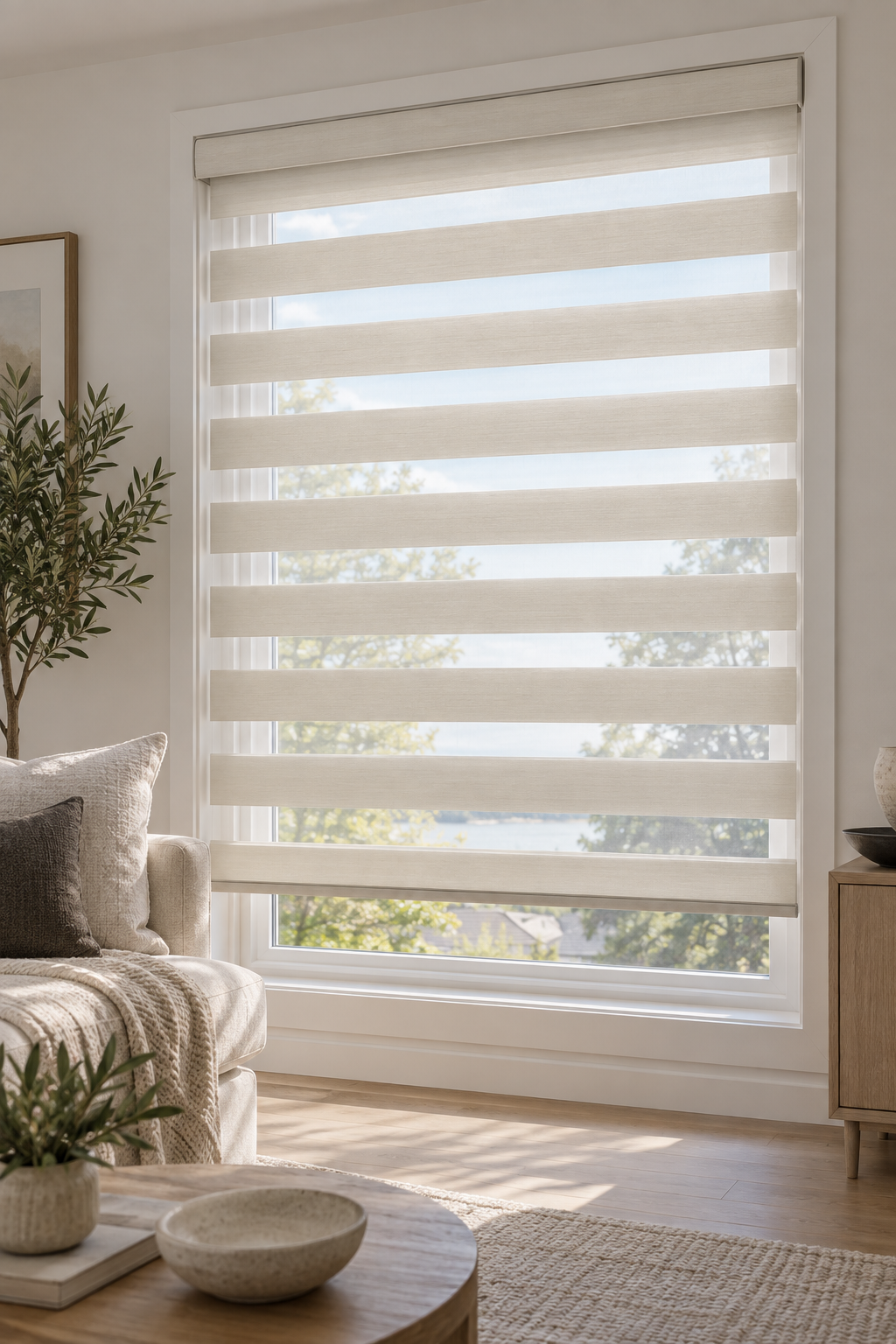
Exterior solar shades are screen-like shades that soften direct sunlight, reduce glare and preserve a filtered connection to the outdoors. They suit bright south- or west-facing windows, large panes, garden doors, offices and some outdoor living areas, but they do not provide dependable nighttime privacy or complete room darkening without another or layered solution.
The right choice depends on what you want to control first: heat and glare, the outdoor view, daytime privacy, nighttime privacy or exposure to wind and weather.
What exterior solar shades do well
A solar shade uses screen-like fabric to soften incoming sunlight. Its openness, colour, mounting position and fit affect how much daylight, glare and outdoor view reach the room.
Lavish Blinds describes solar shades as suitable for south- and west-facing windows, home offices, media spaces, large panes and garden doors. The intended result is a more comfortable room with reduced harsh glare and a cleaner connection to the outdoors. Related reading: Which Material Is Best for Venetian Blinds? Compare Wood, Faux Wood, and Aluminium.
That description does not automatically confirm that every fabric or hardware system is rated for exterior exposure. A shade mounted outside a window, on a balcony or across a porch needs a site-specific review of the opening, mounting surface, weather exposure and operating conditions.
Choose openness around your real priority

Openness describes how much of the fabric allows light and view through. Lower openness generally provides stronger solar filtering and more daytime privacy, while higher openness usually preserves more daylight and view.
Exact performance varies with fabric, colour, sun direction, glass, interior lighting and the surrounding property. Use this table as a decision framework, not as a promise that every category is available for every installation.
| Openness | Daylight and glare | Outdoor view | Daytime privacy | Nighttime privacy | Typical fit |
|---|---|---|---|---|---|
| Lower | Filters more light and glare | More muted | Stronger in many daylight conditions | Not dependable when the room is brighter than outside | Strong exposure and street-facing windows |
| Medium | Balances filtered daylight and glare control | Useful filtered view | Moderate during the day | Limited after dark | Living rooms, offices, large panes and garden doors |
| Higher | Allows more daylight through | Preserves more of the outdoor connection | Weaker where people look directly toward the window | Not dependable | Views, balconies and daylight-focused spaces |
Can you see through solar shades at night?
Often, yes. If the interior is lit and the outdoors is darker, people outside may see silhouettes or activity through the fabric. A low-openness screen can reduce daytime visibility, but no ordinary screen openness should be treated as guaranteed nighttime privacy.
If privacy after dark is essential, discuss a blackout shade, lined treatment, shutter, curtain or layered arrangement. The best solution depends on whether you still need a daytime view and how much space is available around the window.
Heat and glare: why exterior placement matters
Exterior shading can intercept sunlight before it reaches the glass, which is why outdoor placement can be advantageous for solar control. Solar shades also soften harsh brightness and reflections, making a room easier to use during strong daylight.
Every exterior solar shade will not deliver the same level of heat reduction. Window orientation, glass type, fabric openness, fabric colour, shade coverage, gaps and the ability to keep the shade deployed all affect the result. A west-facing opening with low afternoon sun presents a different problem from a shaded north-facing window.
For a home office, the practical target may be reducing screen reflections while preserving an outdoor view. For a living room, you may accept a darker filtered view in exchange for better comfort during the brightest part of the day.
Match the shade to the opening and room

West-facing living room
A west-facing room often needs help during low afternoon sun, when glare can reach across the space. Start with glare reduction and view priorities, then compare lower and medium openness against neighbouring sightlines.
Home office
For a desk near a bright window, glare on a monitor may matter more than complete darkness. A solar shade can soften direct sunlight without closing off the view. Consider the desk, monitor and shade position together.
Large pane or garden door
Large panes and garden doors create both glare and privacy challenges. The consultation should account for handles, door movement, walk-through clearance, shade stacking and how often the covering must be raised.
Screened porch or balcony
An outdoor living area needs more than a fabric choice. Wind movement, rain direction, snow and ice, the mounting substrate, drainage and seasonal operation all matter. Do not assume that an interior solar shade is suitable for a balcony or porch.
Media room or bedroom
If the main goal is a dark screen or darker sleeping space, solar shades may not be the best standalone treatment. They filter light but are not the same as a room-darkening system. Lavish Blinds offers blackout shades for bedrooms, nurseries and media rooms.
Exterior solar shades versus the main alternatives
Solar shades are not automatically better than blinds. They suit a particular combination of view, glare, daylight and privacy priorities. Another treatment may be better if you need darkness, decorative softness, adjustable slats or dependable privacy after sunset.
| Option | View and glare | Darkness and privacy | Exposure | Consider it when |
|---|---|---|---|---|
| Exterior solar shades | Can reduce glare while preserving a filtered view | Daytime privacy varies; nighttime privacy is limited | Exterior fabric, hardware and mounting require confirmation | Solar control and an outdoor connection are priorities |
| Interior solar shades | Can soften glare and preserve a view | Usually limited at night when the room is lit | Protected from weather | You want screen-style light control indoors |
| Blackout shades | Prioritise blocking light over views | Better for darkness and privacy | Usually an interior solution | You need sleep, media viewing or strong privacy |
| Cellular shades | Filtered or room-darkening options | Depends on opacity and fit | Typically interior | You want softer appearance and window comfort |
| Standard blinds | Adjustable slats redirect or limit light | Privacy changes with slat angle | Usually interior | You want structured, adjustable light control |
| Curtains or layers | Reduce glare when closed but reduce views | Can provide strong privacy and darkness | Usually interior | You want softness, decoration or layered coverage |
| Weather-oriented outdoor systems | May provide stronger enclosure | Depends on design | Must be assessed for the actual site | Simple screen fabric may not suit the exposure |
Assess the outdoor site before ordering

An exterior installation should be assessed as part of the building and outdoor space, not as an isolated window. Record conditions that could affect movement, drainage, access and seasonal use.
- Wind: Is the opening exposed on an upper balcony or open corner, or sheltered by a porch?
- Rain: Does water run down the wall or collect near the sill? Is there an overhang?
- Snow and ice: Could accumulation block the bottom rail or freeze against the fabric?
- Freezing temperatures: Can the shade remain retracted through winter?
- Moisture and salt: Is it near a road, pool, treated deck or another source of residue?
- Mounting surface: Is there suitable structure for brackets, including around masonry, cladding or condominium exteriors?
- Clearance: Are handles, doors, railings, lights, vents or furniture in the shade’s path?
- Seasonal operation: Can the shade be retracted, protected or removed when conditions worsen?
There is no universal weather rating for the phrase “exterior solar shades.” Confirm the applicable fabric, hardware, control method and operating limits for the specific opening instead of relying on a rating from an unrelated outdoor blind system.
Maintain and protect the shade seasonally
Exterior solar shades need simple, regular care because dust, pollen, rain residue and ice can collect on the fabric and hardware. Use the cleaning method specified for the selected fabric, typically gentle dusting or rinsing with clean water, and allow the shade to dry before raising it. Related reading: Solar panel cleaning.
- Inspect the fabric, bottom rail, brackets, guides and control components at the start and end of the outdoor season.
- Remove loose dirt before it becomes embedded, and avoid harsh chemicals, abrasive tools and forcing a shade that is frozen or obstructed.
- Retract the shade during severe wind, heavy snow, freezing rain or conditions outside the system’s operating limits.
- Check for fraying, stretched fabric, corrosion, loose fasteners, unusual movement or water collecting near the mounting area.
- Keep drainage paths clear and ensure furniture, planters and railings are not pressing against the shade.
- For seasonal removal or protection, follow the system’s instructions instead of storing damp fabric or dismantling brackets without a plan.
Care requirements vary with the fabric, hardware, location and exposure. Ask for the maintenance instructions that apply to the exact configuration before installation.
Mounting, measurement and operation
Mounting affects coverage, sightlines, clearance and edge light. Depending on the opening, the discussion may include inside or outside mounting, frame depth, wall projection, side gaps, stacking space and access to handles or doors.
Measurement is not simply recording width and height. The installer needs to understand how the window or door moves, where people walk, whether the shade must clear trim and how the fabric will sit when raised or lowered.
Manual, remote-controlled and automated operation are separate decisions from the fabric. Motorization may be worth discussing for a wide opening, hard-to-reach window or group of shades, but power, controls, manual override, wiring and smart-home compatibility must be confirmed for the specific system.
Lavish Blinds offers made-to-measure window coverings and complimentary in-home consultations with real samples. Comparing openness and colour in the actual room is useful because the direction of light and surrounding finishes change how fabric looks.
Prepare for a useful consultation and quote
Bring practical information so the discussion can focus on the right solution instead of unrelated styles.
- List each opening by room and identify windows, garden doors, patio openings, balconies or porch areas.
- Record the strongest daylight direction, especially south or west exposure.
- Describe the main problem: glare, heat, screen reflections, daytime privacy, fading concerns or preserving the view.
- Separate daytime and nighttime privacy expectations.
- Take photos showing frames, trim, handles, doors, railings, ceilings, walls and possible mounting surfaces.
- Note obstructions, furniture, drainage paths, exterior lights, vents and anything that could interfere with movement.
- Decide whether manual operation is convenient or whether remote-controlled or automated operation deserves consideration.
- Describe wind, rain, snow and ice exposure, and whether seasonal retraction is realistic.
- Ask which fabric and hardware are intended for the location, what operating limits apply and how the finished shade should be maintained.
Pricing, availability, installation timing, warranty terms and electrical work depend on the measured opening and selected configuration. A site-specific quote is more useful than assuming an online openness label applies to every window.
FAQ: exterior solar shades in real homes
Are exterior solar shades better than interior blinds for blocking heat?
Exterior placement can have an advantage because it intercepts sunlight before it reaches the glass. Results still depend on exposure, coverage, fabric, colour, glass, gaps and how consistently the shade can be used.
What are the main downsides of exterior solar shades?
The main trade-offs are limited nighttime privacy, reduced view at lower openness, weather exposure, cleaning requirements, possible wind restrictions and more demanding mounting conditions. They also do not automatically provide complete darkness.
Can exterior solar shades stay outside through an Oakville winter?
That depends on the specific fabric, hardware, mounting location and exposure. Snow, ice, freezing temperatures, wind and trapped moisture should be discussed before ordering. If the shade can be retracted during severe conditions, include that in the installation plan.
Are exterior solar shades suitable for a balcony or screened porch?
They can suit some balconies and porches, but suitability cannot be assumed. Wind exposure, attachment points, drainage, railings, access and condominium or building requirements need to be reviewed.
Do solar shades provide complete privacy?
No. Solar shades can provide useful daytime privacy in the right light conditions, but a brighter interior at night can become visible from outside. For stronger privacy, compare blackout, lined, shutter, curtain or layered options.
Choose the next step for your opening
If your main goal is softer glare with a filtered outdoor view, exterior solar shades may be worth assessing. If you need nighttime privacy, complete room darkening or reliable performance in a highly exposed location, take those requirements to the consultation before choosing fabric or hardware. Oakville and GTA homeowners can discuss exposure, view, privacy, mounting and site conditions with Lavish Blinds through a measured solar-shade consultation.