

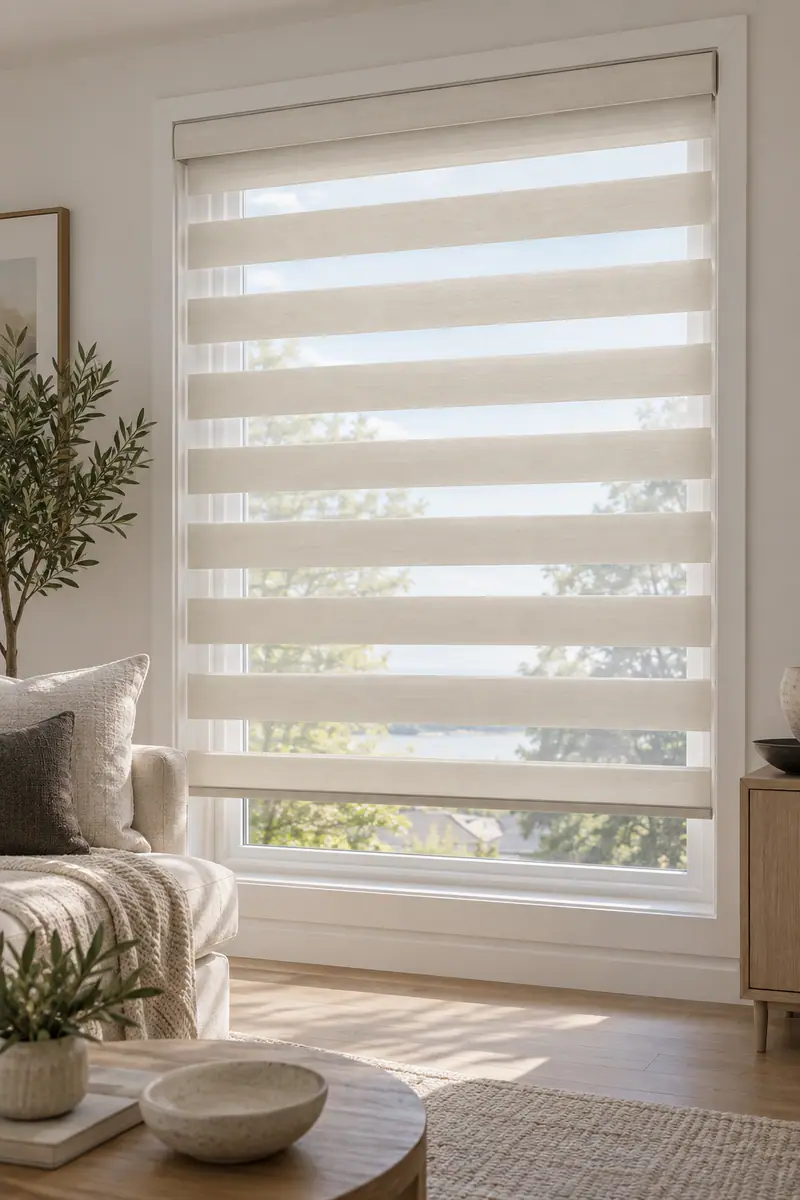
Motorized blinds are most useful for tall, wide, hard-to-reach, or frequently adjusted condo windows, especially when several coverings need coordinated control. Choose the shade style for privacy, glare, daylight, or darkness first, then confirm the power approach, control method, condo rules, mounting conditions, and installation scope in the quote. Related reading: Mississauga Condo Buying Guide: Costs, Documents, and Due Diligence.
For an Oakville condo, the best setup is rarely the same in every room. A bedroom may need room darkening, a living room may need glare control without losing the view, and a sliding patio door needs a covering that stacks clear of the opening.
Why motorization makes sense for some condo windows
Motorization is practical when reaching the window is awkward, several coverings need to move together, or you adjust privacy and daylight throughout the day. It suits windows behind furniture, tall glazing, wide openings, and condo layouts with multiple panels.
Motorization describes how the covering operates. It does not determine whether the fabric is blackout, light-filtering, insulating, or suitable for a particular room. Those are separate decisions based on style, material, opacity, fit, and mounting position.
Lavish Blinds plans motorized blinds and smart shades for tall, hard-to-reach, and frequently adjusted windows. Depending on the selected system, operation can use a remote or compatible smart-home controls. Review the available motorized blinds options before comparing configurations.
Choose the covering before choosing the motor
The covering should solve the room’s main problem before automation is added. Compare privacy, glare, daylight, darkness, appearance, maintenance, and clearance first, then choose the operating method.
| Condo situation | Covering direction | Control approach |
|---|---|---|
| Street-facing living room | Roller or zebra blinds for privacy and adjustable daylight | Remote, grouped, or scheduled control |
| Bedroom facing strong morning or evening light | Blackout roller blinds or shades with careful attention to edge gaps | Remote or scheduled operation |
| Sun-facing window with screen glare | Light-filtering roller, zebra, solar-style, or cellular shade | Grouped or scheduled control |
| Kitchen window | Practical roller, zebra, or easy-care option | Manual if accessible, motorized if awkward or frequently adjusted |
| High or recessed window | Any suitable covering assessed for clearance and access | Remote or smart operation |
| Sliding patio door or wide opening | Roller, vertical, panel, or another configuration planned around movement | Operation that clears handles, travel paths, and daily access |
Roller blinds for a streamlined condo
Motorized roller blinds suit contemporary condos because the single fabric panel has a simple profile. Fabric, opacity, colour, mounting position, and operating style all affect the result. Compare custom roller blinds with other styles before choosing.
Bedrooms and blackout requirements
Select the desired darkness before selecting motorization. Blackout roller blinds and shades can limit incoming light, but gaps at the sides, top, or bottom can still brighten the room. A close made-to-measure fit and suitable mounting position matter as much as the word “blackout.”
Motorization adds convenience, but it does not create blackout performance. The covering, opacity, window coverage, and installation details determine how well the room is darkened.
Living rooms, kitchens, and sun-facing windows
Decide whether the living room needs a view, glare reduction, privacy, or stronger daylight control. Light-filtering fabrics soften brightness, while more opaque options provide stronger privacy and room darkening.
A kitchen window needs a covering suited to its surroundings, cleaning routine, and access. On a sun-facing window, note when glare reaches televisions, monitors, or seating areas. Scheduling can help when the pattern is predictable, but the fabric must still match the required glare and privacy control.
Sliding patio doors and wide windows
For a sliding patio door, choose a covering that moves reliably while keeping handles, panels, and the walking route clear. Ask where it stacks, which direction it moves, how much clearance the hardware needs, and whether the door can open fully without moving the covering every time.
Where motorized blinds get power in a condo
Motorized blinds may use replaceable batteries, rechargeable power, solar assistance where applicable, or a hardwired connection. The right choice depends on the product, window position, servicing access, and whether electrical work is acceptable in the building. Related reading: 7 Motorized Blinds Scheduling Ideas to Try.
| Power approach | Potential advantage | Condo questions |
|---|---|---|
| Replaceable battery | May avoid new wiring | Where is it located and how is it accessed? |
| Rechargeable battery | Can reduce routine battery replacement | Where is charging performed, and is a visible cable needed? |
| Solar-assisted | May suit suitable light exposure | Will orientation and building rules support it? |
| Hardwired | Provides a fixed power connection | Does it require an electrician, permission, or wall access? |
There is no single best power option for every Oakville condo. Battery power may be attractive when opening walls is undesirable, while hardwiring may require more coordination. Ask for the proposed method, access requirements, visible components, and responsibility for electrical work in writing.
Remote, app, scheduled, or smart control
Remote control suits straightforward operation. Grouped, scheduled, app-based, or voice control can help when several coverings need coordinated adjustment. Compatibility depends on the selected motor, control system, and integration.
- Remote: Direct operation without reaching each window.
- Wall control: A fixed control point for convenient everyday use.
- Grouped operation: Several compatible coverings move together.
- Scheduled operation: Useful for predictable privacy, daylight, or bedroom routines.
- App control: Phone-based operation subject to the selected system.
- Voice control: Requires compatibility with the blind system and assistant.
Ask what happens if the remote is lost, the app is unavailable, the internet fails, or power is interrupted. Smart control is not the same as manual override. Confirm whether a local fallback exists and how it works.
Condo rules to check before ordering
Review your condominium corporation’s declaration, by-laws, rules, and property-management procedure before approving the order. Requirements vary where installation affects appearance, drilling, electrical work, shared access, or patio-door and balcony-facing openings.
- Appearance rules for fabrics, colours, headrails, and visible hardware.
- Restrictions on drilling, mounting into frames, or attaching items near windows.
- Approval, insurance, or electrician requirements for hardwired systems.
- Access requirements near balconies, patio doors, or shared exterior areas.
- Contractor registration, insurance, security, elevator, and parking procedures.
- Permitted work hours, deliveries, loading access, and service-elevator rules.
- Notice requirements for management or neighbours using common areas.
Do not assume an interior covering is exempt from approval. A building may still regulate appearance, access, electrical work, noise, or contractor procedures.
What the condo installation process should cover
- Set priorities: Identify needs for privacy, glare reduction, daylight, darkness, view, or access.
- Review windows: Note tall, wide, recessed, unusual, or difficult-to-reach openings, plus handles and furniture.
- Compare covering and controls: Select the style first, then compare manual, remote, grouped, scheduled, app, or smart operation.
- Complete on-site measurement: Assess the opening, mounting surface, clearance, operating path, power route, and access.
- Review the quote: Check every covering, opacity, motor, control, power method, and installation item.
- Coordinate with the building: Provide insurance, registration, work-hour, parking, delivery, or elevator information.
- Prepare the rooms: Move furniture, clear counters and door paths, and provide access to outlets or controls.
- Test and hand over: Check movement, alignment, clearance, controls, grouping, fallback operation, and cleanup.
Lavish Blinds provides in-home guidance, precise measurement, and professional installation. Ask for a written quote covering the selected products and installation scope. Its motorized service considers power, controls, shade type, and the number of coverings moving together.
What affects the quote?
There is no dependable single price for motorized blinds across an Oakville condo. Pricing is shaped by window count and size, covering style, fabric or opacity, mounting, motor and control setup, power approach, grouped operation, access, and installation scope.
Prepare the number of windows, approximate dimensions, photos of frames and obstructions, room priorities, grouping preferences, control goals, existing smart-home equipment, condo requirements, and concerns about drilling, cabling, battery access, or electrical work.
Ask the provider to separate product, motor, control, power, measurement, installation, and building-related scope in the written quote. This makes complete proposals easier to compare.
Questions to ask before approving the order
- What covering, fabric, opacity, and mounting position are proposed for each window?
- Where will the motor and power source sit, and how will future access work?
- Which controls are included, and can coverings operate individually and as a group?
- Does the system support my preferred app, schedule, or voice-control setup?
- What happens during a power, internet, app, or remote interruption?
- How will the installation accommodate handles, furniture, patio doors, and limited clearance?
- Who completes final measurement, and what must be accessible?
- What does installation include for mounting, setup, testing, cleanup, and handover?
- Which product, installation, and support terms will be recorded in the quote?
Frequently asked questions
Can motorized blinds be installed without opening walls or running new wiring?
Sometimes. Battery-based options may reduce the need for new wiring, while hardwired systems can require wall access and building coordination. Confirm the mounting and power method for the specific windows.
Where do motorized blinds get power?
They may use replaceable batteries, rechargeable power, solar assistance where applicable, or a hardwired connection. The motor and window conditions determine which options are available.
What should I ask my condominium corporation?
Ask about appearance, drilling, electrical work, contractor insurance, work hours, elevator and parking procedures, delivery access, and notice requirements. Requirements differ between buildings.
What happens if power, internet, the app, or remote is unavailable?
The result depends on the system. Ask whether there is a local fallback, how the covering behaves during a power interruption, and whether it works without internet.
Are motorized blinds suitable for sliding patio doors?
They can be, provided the design accounts for panel movement, stacking direction, handles, clearance, and access. Confirm that the walking route remains unobstructed.
How much do motorized condo blinds cost?
They are custom-priced. Window size and count, style, fabric, motor and controls, power method, mounting, access, and installation scope affect the quote.
Do motorized blinds work with every smart-home system?
No. Compatibility depends on the motor, control system, app, hub, and voice-assistant setup. Provide your existing equipment before ordering and request confirmation in writing.
Plan your Oakville condo consultation
Bring your room priorities, photos, approximate dimensions, condo requirements, and control preferences to the consultation. Lavish Blinds provides Oakville in-home guidance, precise measurement, power and control planning, and professional installation through its motorized blinds service.