

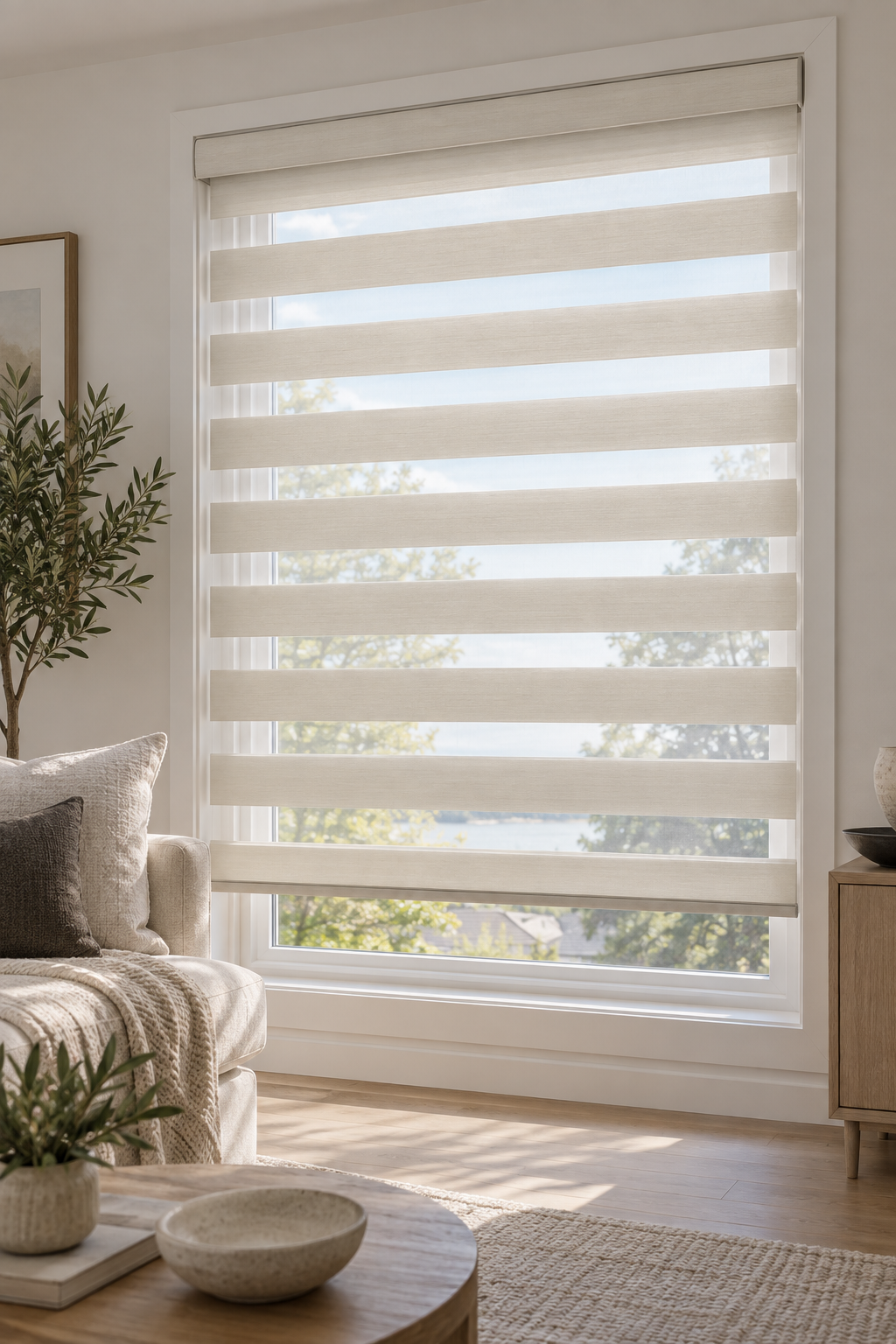
Motorized blinds can make high, oversized, grouped, or hard-to-reach windows easier to operate. However, motorized does not automatically mean smart-home compatible. Integration depends on the complete setup, including the exact motor, controls, power arrangement, hub or bridge, and platform you want to use.
For a Mississauga home, condo, or office, choose the level of operation that suits the window first, then confirm whether the selected system supports your preferred automation. This prevents a common problem: ordering a motorized blind and discovering later that its controls or connectivity do not match the property.
Quick summary

- Manual, remote-controlled, motorized, automated, and smart blinds are related but not identical.
- Motorization may suit skylights, tall windows, large openings, grouped coverings, and difficult-to-reach windows.
- Before ordering, confirm the exact motor, control method, hub, power or charging arrangement, compatibility, manual override, and grouping options.
- Made-to-measure measurement and professional installation affect fit, movement, control placement, and testing.
Choose the Right Level of Blind Operation
A manual blind is adjusted by hand. A remote-controlled blind uses a dedicated remote or similar control. A motorized blind has a powered mechanism, while an automated or smart blind may support grouping, schedules, app control, or connection to a wider home-control system.
These categories can overlap, but they are not interchangeable. A blind may be motorized without connecting to your preferred smart-home platform, and a smart setup may require additional equipment.
| Operation | May suit | Confirm before ordering |
|---|---|---|
| Manual | Accessible windows used occasionally | Whether the control remains easy to reach |
| Remote-controlled | Bedrooms, living areas, or several windows | How many blinds one remote can operate |
| Motorized | High, oversized, skylight, or awkward windows | Power, charging, servicing, and interruption procedures |
| Automated | Rooms needing grouping or schedules | Required control equipment and grouping options |
| Smart | Homes or offices using a broader control system | Compatibility with the exact hub, network, and platform |
A custom blinds buying guide can help you compare window size, mounting, controls, power access, and operating needs before selecting a made-to-measure solution.
Which Mississauga Windows May Benefit from Motorization?

Motorization is most useful when manual operation would be inconvenient or impractical. Examples include tall windows, skylights, wide glazed areas, windows behind furniture, and multiple coverings that need to be adjusted together.
In a bedroom, remote operation can help when windows are difficult to reach. In a home office, motorized blinds may help manage glare at a window behind a desk. In a living room, grouped operation can be useful where several windows face the same direction. Offices and presentation rooms may also benefit when one person needs to control several coverings.
Motorization does not determine privacy, glare, insulation, or room-darkening performance. Those results depend on the covering, fabric or material, opacity, mounting position, window condition, and edge gaps. Choose the motorized system as part of the complete window-treatment design.
Smart-Home Compatibility: What Must Be Confirmed
Compatibility should be confirmed for the complete system, not inferred from the word “smart.” Identify the exact motor model and supported control method, then confirm whether a hub, bridge, receiver, app, wall control, or other equipment is required.
- Motor: Ask which motor is proposed and what controls it supports.
- Hub or bridge: Confirm whether additional equipment connects the blind to another system.
- Power: Establish whether the setup uses batteries, charging, wiring, or another arrangement.
- Platform: Confirm compatibility with the specific smart-home platform.
- Grouping: Ask whether selected blinds can operate together or separately.
- Schedules: Confirm whether timed operation is supported and what enables it.
- Manual override: Ask how the blind works if the remote, app, network, or power is unavailable.
- Servicing: Clarify how motors, batteries, chargers, and controls can be accessed later.
For a clearer explanation of motor types, power options, and platform limitations, review this guide to tubular motor blinds before choosing a smart-home setup. Do not assume compatibility with a particular voice assistant, app, hub, or platform unless the exact model has been confirmed.
Power, Controls, and Everyday Use
Power planning affects convenience and installation. Battery or rechargeable arrangements may reduce visible wiring, but ask how charging works and whether the blind remains accessible for servicing. A wired arrangement may involve different planning requirements. Do not assume electrical or network work is included unless it is explicitly confirmed.
Consider where controls will be used. A remote may suit a bedroom or living room, while a wall control may be more practical in an office or shared space. Ask whether each blind can still be controlled individually when grouped.
Discuss depleted batteries, lost remotes, unavailable networks, and power interruptions. An alternative control method can be important for windows that provide privacy, daylight control, or ventilation.
Match Smart Operation to the Window Covering
Automation should follow decisions about the covering, not replace them. Roller blinds may suit streamlined interiors and controlled light. Cellular or honeycomb shades, Roman shades, Venetian blinds, vertical blinds, shutters, and other custom window coverings may suit different rooms and operating needs.
Before selecting a motor, consider width, height, depth, handles, trim, furniture clearance, mounting position, and how the blind looks when open and closed. These details affect product choice and control placement.
If darkness is important, discuss opacity, side gaps, mounting, and surrounding window conditions. Motorization alone does not make a covering blackout, and automated movement does not guarantee energy savings, improved security, complete privacy, or a specific level of insulation.
Condo and Office Planning in Mississauga
Condo installations may require building approval, advance booking, protected access routes, elevator reservations, specific installation hours, or proof of insurance. Confirm who provides access and whether parking or loading arrangements must be scheduled.
For an office, identify the person approving the design, quote, controls, and installation schedule. Confirm access cards, working-hour restrictions, furniture clearance, and staff notice. If the project involves power, network access, or another building system, establish responsibility for that coordination.
Multiple rooms, large windows, skylights, or grouped controls may require more planning than one accessible window. Allow for measurement, product fulfilment, access, installation preparation, and testing rather than relying on a generic timeframe.
Why Measurement, Installation, and Testing Matter
Made-to-measure blinds require accurate information about every window. Measurements affect coverage, mounting, movement, appearance, clearance, and control placement. They also help determine whether a motorized treatment can operate without contacting handles, trim, furniture, or adjacent coverings.
Professional installation involves more than attaching a blind. The installer should confirm fit, mounting, movement, appearance, control response, and agreed grouping. Motorized or smart blinds should be tested in their intended operating conditions.
Before the installer leaves, request a demonstration. Confirm basic controls, manual operation where applicable, charging or power arrangements, interruption procedures, and whom to contact for adjustments or servicing.
Pre-Order Checklist
- Record each window’s size, access difficulty, handles, trim, and nearby furniture.
- Define priorities such as privacy, glare control, darkness, appearance, and convenience.
- Choose manual, remote-controlled, motorized, automated, or smart operation for each window.
- Request exact motor and control details.
- Confirm power, charging, wiring, and servicing arrangements.
- Ask whether a hub, bridge, app, or wall control is required.
- Confirm compatibility with the intended platform or control system.
- Discuss grouping, individual control, schedules, and manual override.
- Ask what happens during power, battery, remote, or network interruptions.
- Check condo or office access rules, installation hours, parking, elevator, and contacts.
- Confirm what will be tested and what instructions will be provided.
What to Discuss During a Consultation
Lavish Blinds is based in Oakville and serves the Greater Toronto Area, including Mississauga customers. Its service model includes personalized design consultation, free on-site measurement and quotes, made-to-measure blinds, shades and shutters, and professional installation.
Bring your preferred operation method, smart-home details, window photos or plans, building requirements, and concerns about access or charging. The goal is to confirm that the covering, motor, controls, power arrangement, installation plan, and intended use work together.
Frequently Asked Questions
Are motorized blinds automatically compatible with a smart-home system?
No. Motorized describes the powered mechanism. Smart-home operation depends on the exact motor, controls, hub or bridge, power arrangement, network requirements, and platform.
What happens during a power interruption?
Ask whether the blind has a manual override or alternative control method, what happens when batteries are depleted, and how it operates if the remote, app, network, or power is unavailable.
Do Mississauga condos require extra planning?
They may. Check permissions, installation hours, elevator or parking procedures, access requirements, and rules affecting work in the unit before scheduling.
Can motorized blinds be grouped?
Grouping may be available, but the exact arrangement depends on the motor and control system. Confirm whether blinds can operate together, individually, or both.
What should an office confirm?
Confirm the approving contact, access hours, furniture clearance, control locations, power or network responsibilities, building requirements, installation schedule, and testing process.
Make the Integration Decision Before You Order
The best motorized blinds setup starts with the window and the way you use the room. Choose the appropriate covering and operation level, then verify the exact motor, controls, power, compatibility, grouping, manual operation, access, and testing requirements.
For Mississauga homes, condos, and offices, careful planning is particularly valuable when windows are high, oversized, grouped, difficult to reach, or subject to building rules.
To discuss your windows, control preferences, measurement, quote, and installation requirements, contact Lavish Blinds.