

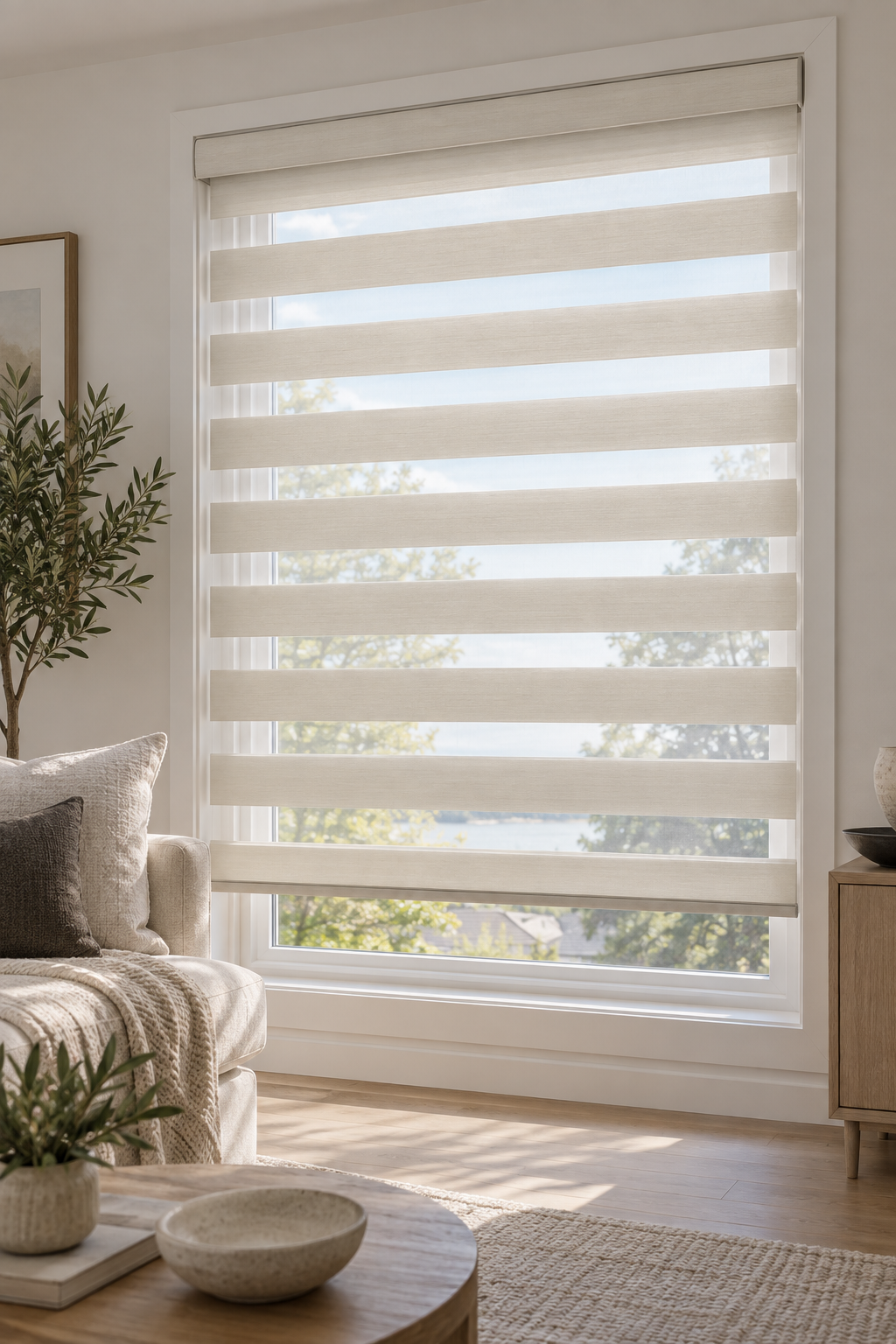
Choosing Roman shade fabric is not only a colour or pattern decision. The fabric’s texture, weight, folds, opacity, lining, and coverage all affect how the shade looks and performs in your room. Mounting position, window dimensions, handles, and the space above the glass matter too.
The best choice balances visual character with everyday needs. Start by deciding whether the room needs softness and decoration, stronger privacy, reduced glare, a darker sleeping environment, or a simple way to manage daylight. Then compare fabric samples in the actual space before ordering.
Quick summary

- Choose Roman shade fabric for both appearance and function, not appearance alone.
- Ask about opacity, lining, coverage, mounting, and likely light gaps separately.
- View samples in the room and at different times of day because surrounding light affects how fabric appears.
- Account for folds, control access, trim, handles, and the fabric stack when the shade is raised.
- Confirm the details through professional measurement before ordering made-to-measure window coverings.
What Roman shade fabric changes
Roman shades use fabric that folds as the shade rises. Compared with a flat treatment, those folds create softness, texture, and a more noticeable decorative presence. A Roman shade can therefore become part of the room’s design rather than simply covering the glass.
Fabric weight and texture influence how prominent that effect feels. A visually quiet fabric may allow the furniture, artwork, or architecture to lead, while a more textured or patterned choice can give the window a stronger role. The fold style and available space also affect how the fabric looks when the shade is partly or fully open.
These characteristics should be considered alongside practical performance. Light and privacy depend on the specific fabric, opacity, lining, coverage, and mounting rather than on the Roman shade category alone. For a useful comparison of the folded appearance of Roman shades and the flatter profile of roller shades, review this explanation of Roman shades and roller shades.
Compare the factors that matter before ordering

Use the following questions to evaluate a sample instead of judging it only by colour. No single fabric characteristic determines the final result.
| Factor | What to consider |
|---|---|
| Appearance | Does the texture, pattern, and visual weight suit the room and the amount of attention you want the window to receive? |
| Opacity | How much daylight should pass through the fabric during the day? |
| Lining | What additional privacy, light-control, or appearance requirements should the lining address? |
| Coverage | Will the shade cover the glass sufficiently for the room’s privacy and daylight goals? |
| Mounting | Would inside or outside mounting work better with the frame, trim, handles, and available clearance? |
| Care | How should the selected fabric and its folds be cleaned and maintained? |
| Raised position | Where will the folded fabric sit when the shade is open, and could it affect the view, trim, or nearby furniture? |
| Operation | Which control style is practical for the window’s location and everyday use? |
Opacity, lining, and coverage are separate decisions
The visible face fabric does not tell you everything about light or privacy performance. Two Roman shades with a similar appearance may behave differently because their opacity, lining, coverage, and mounting arrangements differ.
For a bedroom, you may want to discuss a lining and configuration that support a darker environment. For a living room, preserving some daylight may be more important than maximum room darkening. In either case, ask how the selected fabric and lining are expected to perform at the window rather than assuming that every Roman shade provides blackout coverage.
Coverage matters because the window treatment may not eliminate every gap around the glass. Ask about the relationship between the shade and the frame, the choice between inside and outside mounting, and whether handles, trim, or nearby obstructions affect the installation. These details help set realistic expectations for privacy and light control.
Match the fabric to the room’s priority
Room-by-room planning is more useful than choosing one fabric treatment for the entire home without considering how each space is used. Before finalizing Roman shade fabric choices, compare the room’s privacy, light-control, operating, and styling needs with other available fabric treatments and structured coverings.
Living rooms and dining rooms
These rooms often benefit from a fabric choice that contributes to the overall décor. Consider whether you want the shade to add softness and texture, create a decorative focal point, or remain visually restrained behind the room’s main furnishings.
Look at the sample near the wall colour, flooring, upholstery, and trim. Also consider the folds when the shade is raised. A fabric that looks balanced when lowered may create a stronger visual stack above the glass when open, particularly where the window is close to artwork, shelving, or furniture.
Bedrooms and privacy-focused spaces
In a bedroom, decide how important privacy and darkness are before becoming attached to a particular fabric. Ask about opacity, lining, edge coverage, mounting, and how the shade will operate at night. A decorative fabric alone does not establish how dark or private the room will be.
Also consider access. If the window is behind furniture or difficult to reach, the control style may matter as much as the fabric. Discuss how the shade will be used each day, not only how it looks in a sample.
Rooms affected by glare or strong daylight
For a room affected by glare, assess the window’s orientation, the desired daylight level, the fabric’s opacity, coverage, and how often the shade will be adjusted. A sample viewed in soft indoor light may look different when direct sunlight reaches it.
Roman shades can be part of a broader light-management decision, but do not assume that one fabric will solve every glare, heat, or comfort concern. Discuss the complete window-covering configuration and its expected performance before ordering.
Do not overlook fit, mounting, and raised stack space
A fabric can look right on a sample card and still require careful planning at the window. Measure the opening, note the depth and condition of the frame, and identify trim, handles, nearby walls, furniture, and other obstructions.
Inside mounting places the treatment within the window area, while outside mounting may provide a different relationship to the frame and surrounding wall. The appropriate approach depends on the window, the desired coverage, and the available clearance. Ask how each option affects the appearance of the folds and the amount of glass covered.
Roman shades also need space above the glass when raised. The folded fabric stack, brackets, control position, and nearby trim can affect the view and the operation of the window. This is especially important when the opening is shallow, unusually tall, close to a door, or surrounded by built-in features.
Roman shades or roller shades: which visual direction fits?
Roman shades are a strong option when you want fabric folds, texture, softness, and a more decorative presence. Roller shades offer a flatter, cleaner, and more visually restrained profile, which may suit a room where the window treatment should recede into the background.
The decision is not purely stylistic. Roller shades and Roman shades both require you to consider fabric, opacity, coverage, mounting, operation, privacy, and the space occupied when raised. If folded fabric would compete with the room’s architecture or furnishings, a roller shade may be worth comparing. If a flat treatment feels too plain, Roman shades may better support the intended design.
Roman shade fabric consultation checklist
Prepare these questions before requesting a quote or measurement. They will help turn a general preference into a clear specification.
- Room use: Is the space primarily for relaxing, sleeping, dining, working, or viewing media?
- Light level: Should the fabric filter daylight, preserve a brighter room, or support a darker environment?
- Privacy: What privacy is needed during the day and at night?
- Appearance: Should the fabric add texture and softness, make a decorative statement, or remain quiet?
- Opacity and lining: What does the selected combination provide, and what limitations should you expect?
- Window details: Are there handles, trim, deep or shallow frames, unusual dimensions, or nearby obstructions?
- Mounting: Would inside or outside mounting provide the required coverage and visual result?
- Raised position: How much space will the folded fabric require above the glass?
- Operation: Which control style will be easiest and safest to use every day?
- Care: How should the specific fabric and folds be maintained?
- Project scope: What measurements, materials, product type, and installation details are included in the quote?
Why professional measurement helps
Professional measurement is useful because the decision involves more than the width and height of the glass. An on-site assessment can identify mounting constraints, trim and handle interference, control access, clearance above the window, and the coverage needed for the room’s privacy and light goals.
Lavish Blinds provides personalized design consultation and window-covering services, free on-site measurement and quotes, and professional installation for custom window coverings. Custom pricing varies according to measurements, product type, and materials, so the measurement and quote are the appropriate stage to clarify the specification rather than rely on a generic price.
Frequently asked questions
Should Roman shade fabric be chosen by appearance or light control first?
Consider both from the beginning. Appearance determines how the shade contributes to the room, while opacity, lining, coverage, and mounting affect light and privacy. If one requirement is especially important, such as bedroom darkness or daytime privacy, use it to narrow the fabric choices before making a final style decision.
Does Roman shade lining determine whether a room becomes completely dark?
Not by itself. Lining is one part of the result, along with the face fabric, opacity, shade coverage, mounting position, and gaps around the window. Ask what level of room darkening the complete configuration is intended to provide rather than assuming that a lined Roman shade will eliminate all daylight.
How much space do Roman shades need above the window when raised?
The required space depends on the shade’s dimensions, fabric, fold configuration, hardware, and mounting plan. Ask for the expected raised stack during measurement, particularly if the window is close to a ceiling, door, built-in storage, artwork, or another obstruction.
Should I compare Roman shades with roller shades before choosing fabric?
Yes, especially if you are unsure how much visual presence you want. Roman shades create folded fabric and a softer decorative effect, while roller shades provide a flatter profile. Comparing both helps you decide whether the room needs a fabric feature or a more restrained window treatment.
What should I prepare for a Roman shade measurement appointment?
Know how you use the room, the privacy and light levels you want, whether glare is a concern, and whether you prefer a quiet or more decorative window treatment. Keep the area around the window accessible and point out handles, trim, furniture, doors, and any difficulty reaching the shade.
Make the fabric decision with the whole window in mind
The right Roman shade fabric is the one that works with the room’s visual character and its practical requirements. Compare texture, folds, opacity, lining, coverage, care, operation, mounting, and raised clearance together. View samples in the actual room, then confirm the fit and installation details before ordering.
For homeowners and condo owners in Toronto, Mississauga, Oakville, and the surrounding Greater Toronto Area, Lavish Blinds provides Roman shades, personalized design guidance, free on-site measurement and quotes, and professional installation for custom window coverings.