

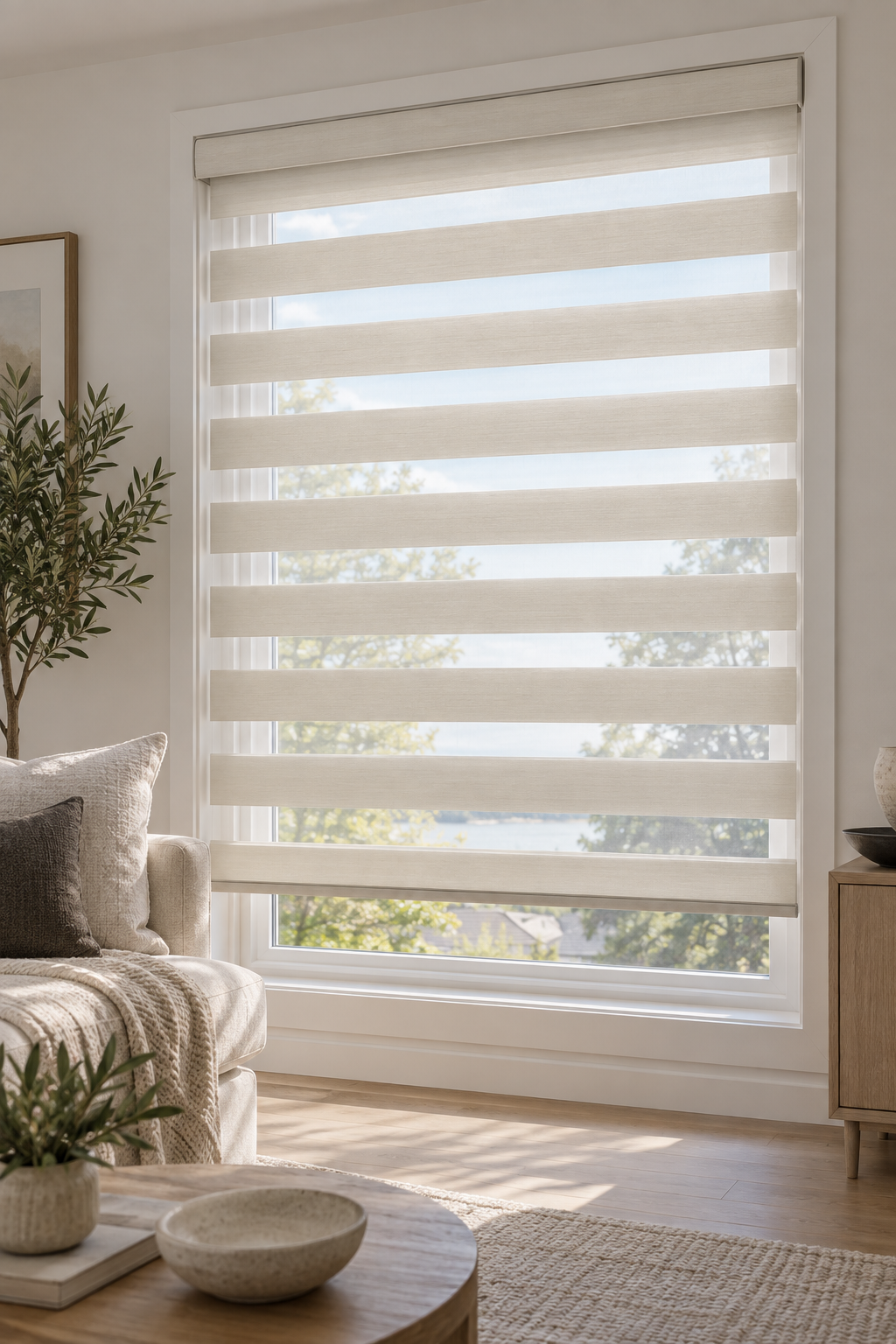
Vertical blinds can suit many sliding doors, patio doors, wide windows, and some office openings, but the door itself should determine the design. The moving panel, available wall space, stack direction, handles, furniture, privacy needs, and operating method all affect whether vertical blinds will work well.
Use the steps below to assess your opening before ordering. The goal is not to assume vertical blinds are always best, but to identify the covering and installation arrangement that will move freely, look appropriate, and support how you use the room.
Quick summary

- Identify which door panel moves and where the covering needs to open.
- Check stack direction, handles, trim, furniture, walkways, and mounting space before choosing a product.
- Compare vertical blinds with roller blinds, shades, and shutters according to privacy, daylight, appearance, and clearance.
- Choose manual, remote-controlled, or automated operation separately from the covering’s light-control performance.
- Use professional on-site measurement for unusually wide, tall, shaped, obstructed, or difficult-to-reach openings.
Step 1: Identify the door and opening configuration
Start by describing the opening in practical terms. It could be a single sliding patio door, several sliding panels, a tall condo opening, French doors, a corner arrangement, or a broad office window. Each configuration creates different requirements for mounting, movement, access, and clearance.
Note which panel moves, which direction it travels, and whether the handle sits close to the frame or glass. If the opening has more than one moving panel, record how the panels overlap and where people normally enter or exit. A treatment that looks suitable across the full width may still obstruct the active panel or create an awkward route through the doorway.
Vertical blinds may be worth considering when a vertical arrangement suits the proportions of the opening and the covering can stack without blocking the door or a usable section of glass. For a closer look at how opening movement, stacking space, and mounting affect the decision, see this guide to vertical blinds for wide windows.
Step 2: Check stacking direction, handles, and clearance

When vertical blinds are open, the vanes gather into a stack at one side or may divide toward both sides, depending on the configuration. The stack must have somewhere to go without covering the moving panel, striking a handle, narrowing a walkway, or colliding with nearby furniture.
Before ordering, stand inside the room and consider the full operating path. Check the wall beside the opening, the position of sofas or desks, the distance to a corner, and whether the door opens onto a busy route. Also check the headrail position against trim, ceiling features, handles, and any obstruction above the door.
Stop and reassess if:
- the stack would block the panel people use to enter or exit;
- the vanes or track would hit a handle, wall, cabinet, or nearby furnishing;
- the covering would reduce a walkway or make the door difficult to reach;
- the mounting surface is too narrow, uneven, high, or obstructed to assess confidently.
Do not solve a clearance problem by guessing at a smaller product. The mounting position, stack size, door movement, and product specification need to be considered together.
Step 3: Define privacy, daylight, glare, and appearance priorities
Next, decide what the covering must do at different times of day. A living room facing a street may need daytime privacy without losing all daylight. A bedroom or media room may place more emphasis on darkness. A home office may need glare control and a clean appearance for screens.
Write down the priorities separately rather than asking for a general “light-blocking” blind. Consider privacy when the vanes are closed, the amount of daylight you want while the door remains covered, direct sun and glare, evening visibility from outside, room darkening, décor, and how often the treatment will be opened.
Vertical blinds can offer adjustable coverage across a wide opening, but the result depends on the product, vane position, mounting, surrounding gaps, and room conditions. Do not treat the product name alone as a promise of complete darkness, total privacy in every position, or guaranteed energy performance.
Step 4: Compare vertical blinds with other coverings
Vertical blinds are one option among several window coverings for sliding doors. The right choice depends on how the opening moves, how the covering will be operated, the visual effect you want, and the space available around the door.
| Option | May suit when | Check before ordering |
|---|---|---|
| Vertical blinds | A vertical format suits a wide or tall opening and the covering needs to move across it. | Stack direction, vane movement, track position, handles, walkway clearance, and door access. |
| Roller blinds | You prefer a streamlined panel and a direct choice of fabric opacity. | Width, fabric suitability, mounting position, side gaps, and whether several blinds are required. |
| Shades | You want a softer fabric appearance or are considering Roman, cellular, or blackout formats. | Fabric behaviour, stack height, room priorities, opening dimensions, and operating method. |
| Shutters | A structured appearance and adjustable panels suit the room and opening. | Frame depth, panel movement, door access, furniture clearance, and available mounting space. |
Roller blinds or shades may be preferable when a simple raised-and-lowered panel better suits the room. Shutters may work when a more architectural appearance is important, provided their panels will not interfere with the door. Vertical blinds may remain the more practical choice where side-to-side movement and broad coverage align with the opening.
Step 5: Choose manual, remote-controlled, or automated operation
Operation is a separate decision from product suitability. A covering can be appropriate for the door but inconvenient if it is difficult to reach, opened frequently, or positioned across a large opening.
- Manual operation: Consider whether everyone can reach the controls comfortably and whether the door is used often.
- Remote-controlled operation: Confirm whether the control operates one covering, several coverings, or a selected group.
- Automated or smart operation: Ask about schedules, grouping, power or batteries, programming, and compatibility with the exact control system.
For motorized blinds, confirm what happens if the remote is unavailable, batteries need attention, or power is interrupted. Ask whether a manual override is available and how the covering can be operated during an interruption. Compatibility with Alexa, Google Home, Apple Home, Matter, or another platform should never be assumed without confirmation for the specific model.
Automation does not determine how much light a covering blocks. Fabric, vane position, mounting, side gaps, and the surrounding opening still affect privacy and light control.
Step 6: Know when to stop DIY measuring
Accurate measurement involves more than recording the width and height of the glass. The installer also needs to understand the mounting surface, trim, handles, door movement, stack location, furniture, and the clearance needed for safe and convenient operation.
Professional on-site measurement is particularly useful for openings that are unusually wide, tall, shaped, obstructed, difficult to reach, close to built-in furniture, or affected by multiple moving panels. It is also sensible when you are uncertain whether an inside or outside mount will allow the door and covering to operate together.
Before requesting a quote, prepare these details. A custom blinds buying guide can also help you check measurements, handles, mounting position, furniture clearance, privacy, and operating space before ordering.
- Opening type and overall width and height.
- Which panel moves and which direction it travels.
- Preferred stack direction and the wall space available for the stack.
- Mounting surface, trim, ceiling height, handles, and nearby obstructions.
- Furniture, cabinets, radiators, walkways, and the normal entry route.
- Privacy, glare, daylight, room-darkening, and appearance requirements.
- Preferred manual, remote-controlled, or automated operation.
- What measurement, fabrication, installation, controls, and aftercare are included in the quote.
Stop DIY measuring if you cannot safely reach the opening, cannot identify a reliable mounting surface, or cannot determine how the door and covering will move together. A measurement that appears precise can still produce a poor result if the installation conditions were misunderstood.
Step 7: Prepare for a reliable blinds installation
Before installation, confirm the proposed track position, stack direction, moving-panel access, control location, and clearance from furniture and walkways. Ask the installer to explain how the covering will operate when fully open, fully closed, and partially adjusted.
For a home or condo, clear the area around the door and identify anything that must remain accessible. For an office or commercial space, consider desks, meeting areas, traffic paths, privacy during working hours, and whether staff need to operate the covering regularly. Lavish Blinds provides custom window coverings for offices and commercial spaces in Oakville, including design guidance, on-site measurement, quotes, and installation.
Keep the quote specific. It should make clear which product is proposed, how it will mount, where it will stack, what operating method is included, and what installation work is covered. If a motorized option is being considered, confirm the power, battery, control, programming, and compatibility details before approving the order.
The same planning principle applies to any installation involving a moving opening: confirm the movement path, surrounding clearance, mounting conditions, and access before work begins. Readers planning other moving-opening projects may find this planning guide for sliding gate installation useful for its focus on clearance and operating space, although window-covering specifications remain specific to the blind and door.
A short Canadian cord-safety note
Long accessible cords on window coverings can pose serious strangulation risks to children. Health Canada explains that Canadian requirements address corded window coverings and recommends replacing products with long accessible cords with newer coverings that do not have them. See the official guidance on window covering safety in Canada.
When requesting a quote for a home, ask which operating configurations are available and how cords, controls, and moving parts will be positioned. Do not assume that every product has the same safety features. Discuss the room, occupants, control location, and installation arrangement with the supplier.
Sliding-door blinds pre-quote checklist
Use this checklist during a consultation or before requesting a quote:
- Have I identified the door type and every moving panel?
- Which direction should the covering open, and where can it stack?
- Will the stack interfere with the active panel, handle, wall, furniture, or walkway?
- What mounting surface is available, and are trim or ceiling features involved?
- Do I need privacy, glare reduction, daylight adjustment, room darkening, or a combination?
- Would vertical blinds, roller blinds, shades, or shutters better suit the opening?
- How often will the covering be operated, and can everyone reach it?
- Do I want manual, remote-controlled, or automated operation?
- If motorized, what are the power, battery, manual override, control, and compatibility details?
- Should the opening receive professional on-site measurement?
- Does the quote clearly state the product, mounting, operation, measurement, installation, and included controls?
Frequently asked questions
Are vertical blinds a good choice for sliding patio doors?
They can be a good choice when their side-to-side movement, stack location, appearance, privacy role, and mounting requirements suit the door. They are not automatically the best option for every patio door, especially where handles, furniture, walkways, or limited wall space create clearance problems.
Which way should vertical blinds stack on a sliding door?
The stack should normally be positioned where it does not block the panel used for entry, interfere with the handle, or narrow a walkway. The correct direction depends on the door’s movement, the room layout, and the available wall space, so it should be confirmed during measurement rather than selected by habit.
Can roller blinds or shades work better than vertical blinds for a sliding door?
Yes. Roller blinds may suit a streamlined look, shades may provide a softer fabric treatment, and shutters may suit a structured appearance. Compare each option according to movement, light control, privacy, mounting depth, stack or lift behaviour, and clearance around the door.
Should sliding-door blinds be measured on site?
On-site measurement is preferable when the opening is unusually wide, tall, shaped, obstructed, difficult to reach, close to furniture, or made up of several moving panels. It helps connect the dimensions with the mounting position, stack direction, handles, trim, and operating clearance.
Are motorized vertical blinds suitable for hard-to-reach patio doors?
They may be suitable when convenient operation is important, but the motor, power source, control method, manual override, grouping, and exact compatibility should be confirmed for the proposed product. Motorization improves control convenience, but it does not by itself determine privacy or light performance.
Conclusion: choose around the door, not just the product name
Vertical blinds make sense when their movement, stack direction, appearance, privacy role, and mounting requirements fit the specific sliding or patio door. Start by identifying the moving panel, then check clearance, define the room’s priorities, compare alternatives, and choose operation separately from light control.
If the opening is unusually wide, high, shaped, obstructed, or difficult to reach, avoid relying on an uncertain DIY measurement. A made-to-measure consultation can connect the product choice with the door configuration, installation conditions, and everyday use.
Lavish Blinds provides made-to-measure vertical blinds and other window coverings, with personalized design guidance, free on-site measurement and quotes, and professional installation.