

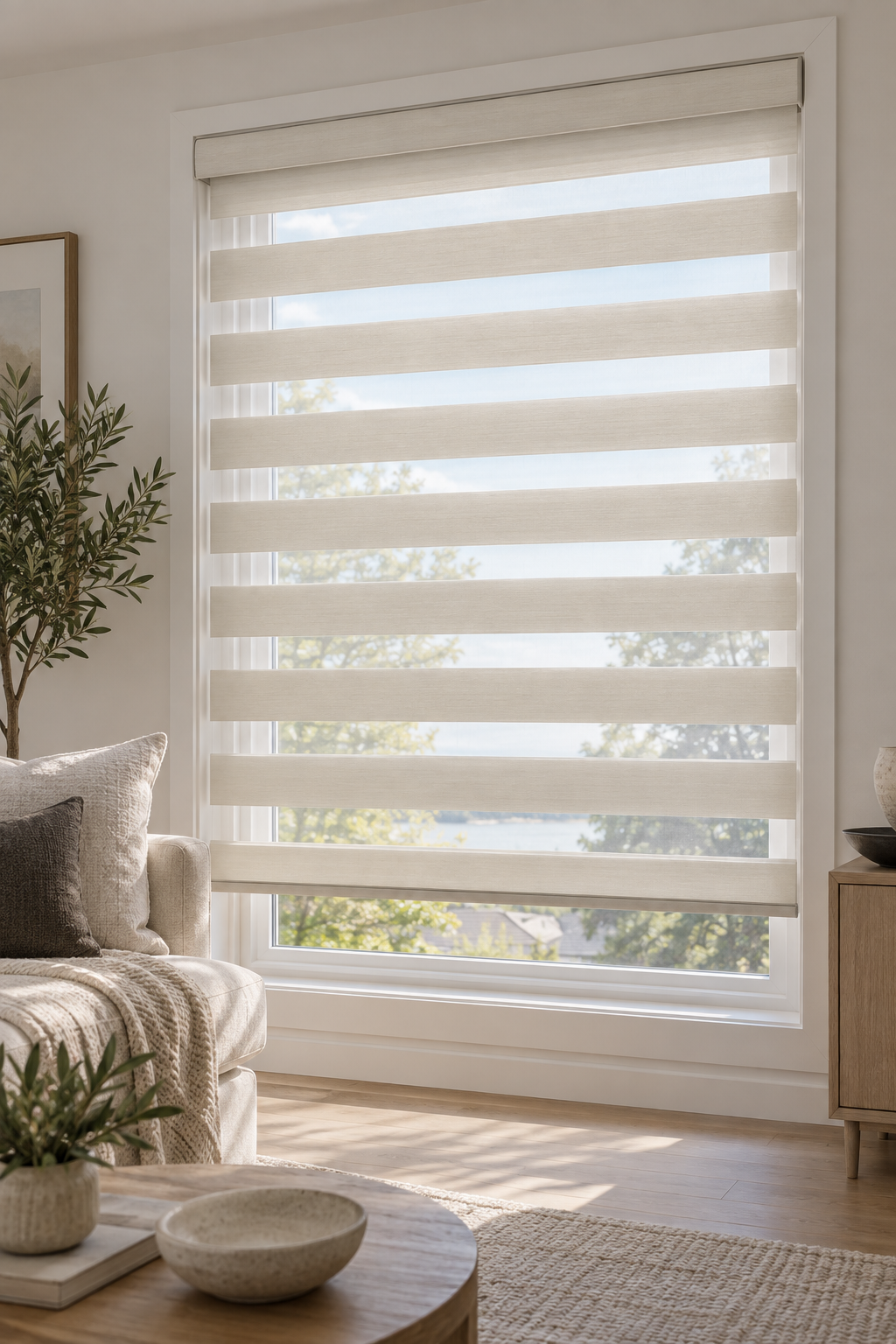
Zebra blinds can be a strong choice when you want to adjust filtered daylight and privacy throughout the day. They are not automatically the best option for every window, however. Roller blinds may provide a cleaner profile, while blackout shades may be more suitable when stronger room darkening is the priority.
There is also an important terminology issue. “Day-night blinds” can describe zebra blinds with alternating fabric bands, but it can also refer to a separate two-shade arrangement with one light-filtering shade and one room-darkening shade. Confirm the exact configuration before comparing quotes or product samples.
Quick summary

- Zebra blinds use alternating solid and more transparent fabric bands to adjust filtered light and visibility.
- Daytime privacy and nighttime privacy are different questions, especially when interior lights are on after dark.
- Zebra blinds are not automatically blackout. Fabric opacity, mounting, fit, and edge gaps all affect darkness.
- Choose roller or blackout options when you want a simpler profile or stronger room darkening. Consider cellular shades or shutters for different comfort or design priorities.
- Before ordering, confirm the product configuration, measurements, mounting space, controls, cord compliance, and installation details.
What Do Zebra and Day-Night Blinds Mean?
Zebra blinds, also called dual shades, banded shades, vision blinds, or zebra shades, use two layers of fabric with alternating opaque and more transparent sections. Adjusting the layers changes how those sections line up, allowing you to move between more filtered daylight and greater privacy without raising the blind completely.
The name “day-night” is sometimes used for this striped construction because it offers different settings for brighter daytime conditions and more private evening conditions. In other product descriptions, day-night means two separate shades installed together: one designed to filter daylight and another designed to provide stronger room darkening. These are not the same design, so ask whether the quote includes one layered zebra shade or two independent shades.
Lavish Blinds lists zebra blinds among its window-covering offerings and provides made-to-measure blinds, shades, and shutters. The useful comparison is not which label sounds best, but which construction provides the control, appearance, and coverage your room requires.
Zebra Blinds Compared With the Main Alternatives

Zebra blinds are most appealing when your priorities change during the day. You may want natural light and some outside visibility in the morning, more privacy during busy hours, and a softer or more private setting in the evening. The layered fabric design supports that flexibility.
Roller blinds use one fabric panel that rolls around a tube. They offer a more direct decision around fabric opacity, colour, and position, which can suit rooms where you prefer a streamlined appearance. Blackout roller blinds or blackout shades may be a better starting point when sleep, presentations, media viewing, or substantial darkness matters more than adjustable filtered light.
Cellular or honeycomb shades deserve consideration when their construction and available specifications align with your comfort and light-control goals. Shutters provide a more architectural appearance and a different approach to privacy and daylight adjustment. Neither alternative is universally better. The right choice depends on the window, room, décor, and daily use.
Comparison Table: Which Option Fits Your Priority?
| Option | Construction and control | May suit | Confirm before ordering |
|---|---|---|---|
| Zebra blinds | Alternating fabric bands adjust filtered light and visibility. | Living rooms, condos, home offices, and street-facing windows where daylight and privacy change. | Nighttime privacy, fabric opacity, edge gaps, mounting, and whether the product is one shade or a two-shade system. |
| Roller blinds | One fabric panel rolls around a tube. | A clean, streamlined appearance and a direct choice of opacity. | Fabric opacity, glare needs, privacy, mounting position, and operating access. |
| Blackout shades | Fabric and fit are selected for stronger room darkening. | Bedrooms, media rooms, and spaces where darkness is a leading requirement. | Edge coverage, side gaps, top gaps, mounting, and the difference between strong darkening and complete darkness. |
| Cellular shades | A structured shade format with a different visual and functional profile. | Rooms where a softer shade appearance or specific comfort goals matter. | Opacity, mounting depth, configuration, and care requirements. |
| Shutters | Architectural panels or louvres provide adjustable coverage. | Interiors where a substantial, built-in-looking finish is desirable. | Frame depth, panel movement, window shape, clearance, and how the panels will operate. |
Privacy, Daylight, Glare, and Darkness: The Trade-Offs
Daytime privacy
During the day, zebra blinds can help soften the view into a room while retaining some daylight. The exact result depends on the alignment of the fabric bands, the fabric’s transparency, the angle of outside views, and the lighting conditions. A transparent section that feels private in one setting may provide less privacy when viewed from a different angle or distance.
Nighttime privacy
After dark, interior lighting can change the balance. A window that appears reasonably private from inside during daylight may reveal more of the room when the interior is brighter than the outside. Test or discuss nighttime privacy separately, particularly for bedrooms, bathrooms, ground-level rooms, and street-facing windows.
Filtered light versus blackout
Filtered daylight is not the same as blackout. Zebra blinds may reduce glare and soften incoming light, but they should not automatically be described as providing a dark bedroom or complete room darkening. Fabric selection, inside or outside mounting, window coverage, side gaps, top gaps, and bottom fit all influence the result.
If darkness is the leading requirement, compare blackout roller blinds or blackout shades and ask how the proposed installation addresses the edges of the window. If the priority is flexible daylight rather than maximum darkness, zebra blinds may be the more natural starting point.
Which Window Covering Fits Each Room?
Living rooms and open-plan spaces
Zebra blinds can work well in living areas where you want to adjust daylight and privacy without fully raising the treatment. Their layered fabric effect adds visual texture, while the ability to change the band alignment can be useful as daylight moves across the room.
Bedrooms
Begin with the required level of darkness rather than the product name. Zebra blinds may suit a bedroom where filtered light and changing privacy are acceptable. If sleep, shift work, or strong room darkening is the priority, compare blackout shades or blackout roller blinds and pay close attention to installation gaps.
Condos and street-facing windows
Condos often need a careful balance between outside visibility, daytime privacy, and a finished appearance. Zebra blinds can be a useful option when those needs change throughout the day, but nighttime privacy should be checked with the room lights on. Mounting depth and nearby handles, trim, or furniture should also be assessed before the product is selected.
Home offices
For a home office, consider screen glare, video-call backgrounds, outside visibility, and how often the window covering will be adjusted. Zebra blinds may offer flexible daylight control, while roller blinds can provide a simpler, more uniform background. If the window is difficult to reach, ask whether remote-controlled or automated operation is available for the selected product.
Office and commercial spaces
In an office, consistent appearance across several windows may matter as much as individual window performance. Roller blinds can create a coordinated, streamlined look, while zebra blinds may offer more adjustable daylight and privacy. Consider meeting rooms, desks, monitors, reception areas, and operating access before choosing one format for every space.
Window coverings are only one part of a commercial property plan. If an office project also involves site protection, keep that separate specification work distinct from the interior treatment decision, as outlined in these commercial security fencing considerations.
Operation and Canadian Cord-Safety Considerations
Operation is part of the product decision, not a finishing detail. Manual controls may be suitable for accessible windows used occasionally. Remote-controlled or automated blinds may be more convenient for hard-to-reach windows, multiple coverings, or rooms where you want to adjust several treatments together.
Do not assume that every zebra blind includes motorization or that every control system has the same power, access, or compatibility requirements. Confirm whether the selected product is manual, remote-controlled, or automated, how it is powered, how it is operated during an outage, and whether the controls suit the intended room.
Canadian buyers should also ask how the proposed window covering meets current cord-control requirements. Health Canada states that the Corded Window Coverings Regulations came into effect in 2021 and that products with long accessible cords are no longer allowed for sale in Canada. The Government of Canada guidance on blind and window-covering safety provides the relevant background.
What to Check Before Ordering Zebra Blinds
Use this checklist during a consultation or when comparing written quotes:
- Product meaning: Is this one zebra shade with alternating bands, or a separate two-shade day-night configuration?
- Window dimensions: Which measurements will be taken, and will each opening be measured individually?
- Mounting: Is an inside or outside mount appropriate? Is there enough depth for the headrail and fabric layers?
- Clearance: Will handles, trim, furniture, sliding doors, or nearby windows interfere with operation?
- Privacy: How will the selected fabric perform during the day and with interior lights on at night?
- Darkness: Is the goal filtered daylight, glare reduction, strong room darkening, or near-total darkness? What gaps remain after installation?
- Controls: Will the blind be manual, remote-controlled, or automated? Confirm access, power, and any compatibility requirements.
- Safety: What cord-control design is included, and does the proposed product comply with Canadian requirements?
- Installation: Who will install the blinds, and how will the finished fit and operation be checked?
Why Made-to-Measure Measurement and Installation Matter
Standard assumptions about window size can create problems with coverage, alignment, operation, and consistency. Made-to-measure blinds account for the actual opening, surrounding trim, mounting space, furniture, and the way the room is used. This is particularly important for large windows, skylights, sliding doors, multiple adjacent openings, and windows with limited clearance.
Professional installation also helps connect the product decision to the finished result. The installer can confirm the mounting position, check movement and clearance, and help ensure that multiple treatments create a consistent appearance. Lavish Blinds describes an end-to-end service that includes personalized design guidance, free on-site measurement and quotes, and professional installation in Oakville and the surrounding GTA service area.
A Simple Decision Path
- Choose zebra blinds first if your main goal is adjustable filtered daylight, changing privacy, and a layered fabric appearance.
- Choose roller blinds if you prefer a cleaner profile and a straightforward decision around fabric opacity and colour.
- Choose blackout shades or blackout roller blinds if stronger room darkening is more important than flexible filtered light.
- Consider cellular shades when their specific construction and comfort characteristics better match the room’s requirements.
- Consider shutters when you want a more architectural treatment and have sufficient frame depth and operating clearance.
- Before committing, verify the exact product configuration, privacy at night, mounting, gaps, controls, cord compliance, measurement, and installation.
Frequently Asked Questions
Are zebra blinds and day-night blinds the same thing?
Not always. Day-night blinds may mean zebra blinds with alternating fabric bands, or a separate system using one light-filtering shade and one room-darkening shade. Ask for a product description or sample that makes the configuration clear.
Do zebra blinds provide privacy at night?
They may provide a more private setting when the bands are aligned appropriately, but nighttime privacy depends on the fabric, alignment, outside sightlines, and interior lighting. Evaluate daytime and nighttime performance separately.
Can zebra blinds make a bedroom completely dark?
Do not assume so. Zebra blinds are commonly used for filtered light and adjustable privacy, not automatically for complete darkness. For a bedroom requiring stronger darkening, compare blackout shades or blackout roller blinds and discuss edge coverage.
Are zebra blinds suitable for condos and street-facing windows?
They can be a useful starting point because privacy and daylight needs may change throughout the day. Check nighttime visibility, mounting space, window handles, and nearby trim before ordering.
What should I confirm before ordering motorized zebra blinds?
Confirm that motorized operation is available for the selected product and window size. Ask about the control method, power requirements, access during an outage, automation options, and compatibility with the way you plan to use the room.
Do Canadian window coverings need to be cordless?
Health Canada states that long accessible cords are no longer allowed for window coverings sold in Canada under the Corded Window Coverings Regulations. Ask the supplier to confirm the cord-control design and compliance of the specific product.
Choose Around the Room, Not Just the Label
A useful zebra blinds day-night comparison starts with the result you want. Zebra blinds are well suited to adjustable filtered daylight and changing privacy, while roller, blackout, cellular, and shutter options may better address a cleaner appearance, stronger darkening, different comfort goals, or a more architectural finish.
Before ordering, confirm whether “day-night” refers to a zebra construction or a two-shade system, then review privacy after dark, fabric opacity, mounting, gaps, clearance, operation, safety, and installation. A made-to-measure assessment can help translate those requirements into a practical window-covering plan.
For design guidance, free on-site measurement and quotes, and professional installation of made-to-measure blinds, shades, and shutters in Oakville and the GTA, contact Lavish Blinds.